Full Contact Twist alternatives....


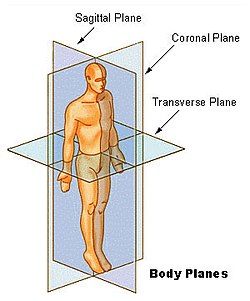
Stephan asked about alternatives to the full contact twist. I think that the key thing is that you need to think of movements that will involve some rotation. Too often, movements are forward and backward ( in the sagittal plane) - think the bench press - or side to side (in the frontal/coronal plane) - e.g. the press or squat.

However, in real life, Every muscle and joint in the body functions in three planes of motion simultaneously. If we are goign to be fit for real life then we need to work in those three planes and that will mean introducing some motion in the transerve plane - twisting with a strong core at the centre. ( Gambetta explains much of this stuff here.)

The full contact twist does that, but it is not the only such movement...you can think up your own, but try some woodchop variations:


or with a med ball


or use a hammer and shovel.....


The important thing is to rotate a bit. It is where the power comes from. Think of a punch - the power is in the twist not the sagittal plane.

Comments

Stephan Guyenet said…
Thanks Chris. I like the woodchop motion. I've been looking for a way to incorporate twisting ever since I did some gravel shoveling and realized how weak my twist is! I think I can do the woodchop with dumbbells or plates in my gym.
Rannoch Donald said…
Hi Chris,

I recommend Figure 8 Holds using a suitably heavy Kettlebell. you can see them here...

http://www.youtube.com/watch?v=_oA3GOE86d8&eurl=http://simplestrength.blogspot.com/search?updated-max=2008-04-27T10%3A54%3A00Z&max-results=3

Trick is to go HEAVY!
Anonymous said…
I can tell you from much experience in this area that twisting under load is relatively a high risk activity, especially if it includes flexion or extension which will add disk compression. There is a safer approach: resisting against a rotational force. Stabilization is the core's primary function which protects the spine. Doing single arm pressing and pulling movements at a cable machine challenges the obliques to stabilize the spine against a rotational force safely and effectively. I can guarantee that the exercises offered here are higher risk for spine injury in comparison.
Chris said…
Rannoch - thanks for that.

Anon - there is always a danger, but I think people must proceed with care. Do no harm is a great maxim - thansk Rannoch - but I believe tht rotation is a natural movement. I like single arm presses pulls and deadlifts, but there is more to it than stabilisation. I'm not saying that you need to go really heavy, but rotation is important.
Rannoch Donald said…
Anon - It's all about context. Moving at speed and with power is inherently dangerous, that is why we train for it. And yes, resisting twisting motion is a key role of core strength but that resistance is direclty related to the initial power expressed. Otherwise we would simply have a singular column supporting the torso. But we dont. The lumbar spine supports whilst the thoracic spine acts like a spring. So, What makes sense? To restrain the spring or to learn how to use it's power?

Finally, for the average person, these drills maybe a little extreme. We however choose not to be average.
Rannoch Donald said…
Another thought...

Certainly in terms of Martial arts we use kinetic linkage and spiralling to direct forces through the body which is critical to distributing forces through the body that might otherwise cause injury.
Anonymous said…
Chris, rotation is a natural movement, the question in terms of safety is a matter of when and how. Rotate with abandon when there is little or no load. This is actually therapeutic for the discs which have no blood supply and rely on the massaging effect of movement to stay flexible, hydrated and supplied with nutrients. The rules change, however when loading the spine. Now it is about limiting movement.

I would highly recommend that you study sports movement closely and observe how the body seeks to limit spinal twisting. The goal, conscious or not in natural movement, is to have the shoulders and hips moving in unison as much as possible to minimize twisting the spine. Take a look, for instance, at a golf tee shot, which is highly rotational, and you will notice how the hips move to maintain alignment with the shoulders. The golfer is standing initially with hips at a right angle to the intended direction of the flight of the ball. They then rotate away and then ultimately toward the fairway ahead following the much more dramatic movement of the upper torso. The spine is not splinted, however, athletic performance does require *some* rotational movement but believe me when I tell you the primary effort is in minimizing that movement in order to protect the spine.

As rannoch pointed out there is inherent danger in sports performance. One of the points of stylized training in the gym is to be able to condition the body safely, maximizing results while minimizing risk. Then that conditioning works to advantage during actual sport specific training. Sport specific training enables the body to develop the proper balance between spinal stability and movement.

It is also worth pointing out that extreme performance can come at a cost later in life. Those who choose short term gain over long term health do so at their own risk.

Why am I saying these things so definitively? Because I do sport specific athletic conditioning, injury rehab and post surgery rehab, I work with the elderly, I work with people with spinal stenosis, spinal fusion, scoliosis, disc compression and disc deformation (herniated disc).

My suggestion for those following this thread is don't take my word for it, do some research so you can exercise safely and stay healthy and fit to a ripe old age.
Chris said…
Anon - thanks for your comment. You raise some valuable points that I need to think on.
Rannoch Donald said…
Anon,

Would like to discuss more should you care to email me rannoch at kettlebellsscotland.com

thanks for the comments so far.

Rannoch
Anonymous said…
This comment has been removed by the author.

Popular posts from this blog

Dry January

I mentioned a few weeks ago that I was taking part in "Dry January".  I didn't make a big song and dance about it, but I decided to go for a calendar month or so with no alcohol.  A few people have asked me about my experience, so here are a few points. Why take a break from drinking? Alcohol is an interesting topic.  As a drug it is widely accepted in society, central to so much of our socialising and leisure.  There seem to be lots of health benefits - so we are told - yet there are also a lot of problems in terms of health, relationships and lifestyle that come from drinking. Over a few years I'd begun to become aware and then concerned that I was drinking too much and too regularly.  I am in a busy and stressful job and sometimes a glass of wine after work to relax is really helpful.  But over time, one glass became two.  Two glasses became ....I might as well finish the bottle.  A habit got established....and was starting to get too e...

So where have I been?

You will have noticed that this blog has been quiet for a while....  There are a few reasons for that, reasons that I thought I'd list here: WORK -  my day job has been incredibly busy and stressful this year. Working 10-14 hour days the last thing on my mind when I got home was putting something on here.  FACEBOOK/TWITTER - I suppose I've been using other channels to do some of what I used to do here. Quick fire posts pointing to interesting studies or news etc tend to get posted to Twitter (@chrishighcock) or to the Facebook Hillfit group http://www.facebook.com/groups/263083947097000/  REASSESSMENT - I've found myself less comfortable with some of the positions I've taken in the past. Sometimes I'm embarrassed by some of the things I've promoted. I'm not Paleo or low carb. I think Tabata and intervals are misunderstood and misapplied. I cannot really claim to be HIT.   I find myselfunable  honestly to post things on here and pretend that I am some sort o...

Taking up space for a brief update

I've a couple of posts in draft that I will get up soon -  an update / reflection on Dry January and some thoughts on the scheduling benefits of short workouts if your life is busy.  Before that though, I am pointing to something else. However, I wanted to highlight something that is coming this weekend that I've been involved in.   Amber Rogers (Gokaleo and author of Taking Up Space ) has been pulling together a bundle of books from various authors with a common theme, one that I've been pushing here recently.   Keep it simple, avoid the hype, be patient, be consistent and flee the gurus.   I've talked before about how we get obsessed with pushing for more and more, when enough is OK.  I've given my view that so much of the health and fitness internet world is more like a gnostic religion than something that will benefit your life. There are other voices out there saying similar things and I'll be pointing to a bundle of books later this week ...