I did not realise that sprinting was about differential calculus! I wish he had been teaching me maths 25 years ago.

Showing posts with label sprint. Show all posts
Showing posts with label sprint. Show all posts
Thursday, February 16, 2012
Usain Bolt and differential calculus
I love this guy's videos.....
I did not realise that sprinting was about differential calculus! I wish he had been teaching me maths 25 years ago.
I did not realise that sprinting was about differential calculus! I wish he had been teaching me maths 25 years ago.


Wednesday, May 25, 2011
The single best exercise
I thought that this was an interesting article. The journalist asked what different experts considered to be the single best exercise. The conclusion seems to be hill sprints or at least sprints up stairs.
That is the view of Martin Gibala. He is the guy who has been doing a lot of research recently on the imapct of interval training, generally finding that short sprints can have the same effects as endurance exercise and that you also do not need to be flat out in the sprints to get the benefits.
The full paper for that last one is here.
The approach seems promising, since most of us have minimal time to exercise each week. Gibala last month published a new study of H.I.T., requiring only a stationary bicycle and some degree of grit. In this modified version, you sprint for 60 seconds at a pace that feels unpleasant but sustainable, followed by 60 seconds of pedaling easily, then another 60-second sprint and recovery, 10 times in all. “There’s no particular reason why” H.I.T. shouldn’t be adaptable to almost any sport, Gibala said, as long as you adequately push yourself.
Of course, to be effective, H.I.T. must hurt. But a study published last month found that when a group of recreational runners practiced H.I.T. on the track, they enjoyed the workout more than a second group of runners who jogged continuously for 50 minutes. The H.I.T. runners, the study’s authors suspect, were less bored.
The only glaring inadequacy of H.I.T. is that it builds muscular strength less effectively than, say, the squat. But even that can be partially remedied, Gibala said: “Sprinting up stairs is a power workout and interval session simultaneously.”Meaning that running up steps just might be the single best exercise of all.
That is the view of Martin Gibala. He is the guy who has been doing a lot of research recently on the imapct of interval training, generally finding that short sprints can have the same effects as endurance exercise and that you also do not need to be flat out in the sprints to get the benefits.
The full paper for that last one is here.
Saturday, March 5, 2011
Sprints are fun
This is an interesting one from the perspective of much of what I put up here: Sprints are more fun than endurance running. Too many people give up on exercise because it is boring
High-intensity interval running is perceived to be more enjoyable than moderate-intensity continuous exercise: Implications for exercise adherence.
Abstract
The aim of this study was to objectively quantify ratings of perceived enjoyment using the Physical Activity Enjoyment Scale following high-intensity interval running versus moderate-intensity continuous running. Eight recreationally active men performed two running protocols consisting of high-intensity interval running (6×3 min at 90% VO(2max) interspersed with 6×3 min active recovery at 50% VO(2max) with a 7-min warm-up and cool down at 70% VO(2max)) or 50 min moderate-intensity continuous running at 70% VO(2max). Ratings of perceived enjoyment after exercise were higher (P < 0.05) following interval running compared with continuous running (88 ± 6 vs. 61 ± 12) despite higher (P < 0.05) ratings of perceived exertion (14 ± 1 vs. 13 ± 1). There was no difference (P < 0.05) in average heart rate (88 ± 3 vs. 87 ± 3% maximum heart rate), average VO(2) (71 ± 6 vs. 73 ± 4%VO(2max)), total VO(2) (162 ± 16 vs. 166 ± 27 L) or energy expenditure (811 ± 83 vs. 832 ± 136 kcal) between protocols. The greater enjoyment associated with high-intensity interval running may be relevant for improving exercise adherence, since running is a low-cost exercise intervention requiring no exercise equipment and similar relative exercise intensities have previously induced health benefits in patient populations.
High-intensity interval running is perceived to be more enjoyable than moderate-intensity continuous exercise: Implications for exercise adherence.
Abstract
The aim of this study was to objectively quantify ratings of perceived enjoyment using the Physical Activity Enjoyment Scale following high-intensity interval running versus moderate-intensity continuous running. Eight recreationally active men performed two running protocols consisting of high-intensity interval running (6×3 min at 90% VO(2max) interspersed with 6×3 min active recovery at 50% VO(2max) with a 7-min warm-up and cool down at 70% VO(2max)) or 50 min moderate-intensity continuous running at 70% VO(2max). Ratings of perceived enjoyment after exercise were higher (P < 0.05) following interval running compared with continuous running (88 ± 6 vs. 61 ± 12) despite higher (P < 0.05) ratings of perceived exertion (14 ± 1 vs. 13 ± 1). There was no difference (P < 0.05) in average heart rate (88 ± 3 vs. 87 ± 3% maximum heart rate), average VO(2) (71 ± 6 vs. 73 ± 4%VO(2max)), total VO(2) (162 ± 16 vs. 166 ± 27 L) or energy expenditure (811 ± 83 vs. 832 ± 136 kcal) between protocols. The greater enjoyment associated with high-intensity interval running may be relevant for improving exercise adherence, since running is a low-cost exercise intervention requiring no exercise equipment and similar relative exercise intensities have previously induced health benefits in patient populations.
Sunday, February 21, 2010
Sprinting boosts Testosterone
at least it does in adolescent boys:
Androgen Responses to Sprint Exercise in Young Men
The purpose of this study was to investigate the effects of a 6-month sprint training program on plasma androgens and catecholamine (CA) concentrations in response to a 6 s sprint in adolescent boys [training group (TG), n=6; control group (CG), n=6]. A 6 s-sprint test was performed on a cycle ergometer before and after training (Pre-T and Post-T, respectively). Plasma total testosterone (TT), bioavailable testosterone (BT), and CA concentrations were measured at rest, after a warm-up, immediately after a 6 s-sprint, and during the recovery (i. e. 5 and 20 min). After training period, plasma TT concentrations increased significantly at the end of the sprint and during the recovery in the TG. No effects for sampling times and period were observed in BT levels. Plasma TT concentrations after 5 min of recovery were positively correlated with the corresponding values of plasma lactate (La) concentrations and with post-6 s-sprint plasma adrenaline (A) concentrations (r=0.52; p<0.01 and r=0.61; p<0.01, respectively). These results suggest that sprint training increases plasma TT concentrations in response to sprint exercise in adolescent boys. Plasma A and plasma La concentrations increases in response to sprint exercise could be involved in this elevation of plasma TT concentrations.
Androgen Responses to Sprint Exercise in Young Men
The purpose of this study was to investigate the effects of a 6-month sprint training program on plasma androgens and catecholamine (CA) concentrations in response to a 6 s sprint in adolescent boys [training group (TG), n=6; control group (CG), n=6]. A 6 s-sprint test was performed on a cycle ergometer before and after training (Pre-T and Post-T, respectively). Plasma total testosterone (TT), bioavailable testosterone (BT), and CA concentrations were measured at rest, after a warm-up, immediately after a 6 s-sprint, and during the recovery (i. e. 5 and 20 min). After training period, plasma TT concentrations increased significantly at the end of the sprint and during the recovery in the TG. No effects for sampling times and period were observed in BT levels. Plasma TT concentrations after 5 min of recovery were positively correlated with the corresponding values of plasma lactate (La) concentrations and with post-6 s-sprint plasma adrenaline (A) concentrations (r=0.52; p<0.01 and r=0.61; p<0.01, respectively). These results suggest that sprint training increases plasma TT concentrations in response to sprint exercise in adolescent boys. Plasma A and plasma La concentrations increases in response to sprint exercise could be involved in this elevation of plasma TT concentrations.
Friday, January 22, 2010
How fast can you go?
Bolt in winning that went at about 28mph.
A new study says that theoretically humans could go at 40mph!
Human Running Speeds of 35 to 40 Mph May Be Biologically Possible
The researchers said the new work shows that running speed limits are set by the contractile speed limits of the muscle fibers themselves, with fiber contractile speeds setting the limit on how quickly the runner's limb can apply force to the running surface.
"Our simple projections indicate that muscle contractile speeds that would allow for maximal or near-maximal forces would permit running speeds of 35 to 40 miles per hour and conceivably faster," Bundle said.
Here is the abstract:
The biological limits to running speed are imposed from the ground up
Running speed is limited by a mechanical interaction between the stance and swing phases of the stride. Here, we tested whether stance phase limitations are imposed by ground force maximums or foot-ground contact time minimums. We selected one-legged hopping and backward running as experimental contrasts to forward running, and had seven athletic subjects complete progressive discontinuous treadmill tests to failure to determine their top speeds in each of the three gaits. Vertical ground reaction forces (in body weights; Wb) and periods of ground force application (Tc; s) were measured using a custom, high-speed force treadmill. At top speed, we found that both the stance-averaged (Favg) and peak (Fpeak) vertical forces applied to the treadmill surface during one-legged hopping exceeded those applied during forward running by more than one-half of the body's weight [Favg = 2.71 ± 0.15 vs. 2.08 ± 0.07 Wb; Fpeak = 4.20 ± 0.24 vs. 3.62 ± 0.24 Wb±sem] and that hopping periods of force application were significantly longer [Tc = 0.160 ± 0.006 vs. 0.108 ± 0.004 s]. Next, we found that the periods of ground force application at top backward and forward running speeds were nearly identical, agreeing to within an average of 0.006 s [Tc = 0.116 ± 0.004 s vs. 0.110 ± 0.005 s]. We conclude that the stance phase limit to running speed is imposed, not by the maximum forces that the limbs can apply to the ground, but rather by the minimum time needed to apply the large, mass-specific forces necessary.
Tuesday, November 3, 2009
It is all about genetics - your toes are too short!
When it comes to sporting performance, you know ultimately it is all about genetics - the hand that you were dealt by your parents.
There is a lot of talk about how to train, how to eat etc but when it comes to it it is about things that you really cannot influence.....like the length of you toes!
Longer toes, unique ankle structure aid sprinters
There is a lot of talk about how to train, how to eat etc but when it comes to it it is about things that you really cannot influence.....like the length of you toes!
Longer toes, unique ankle structure aid sprinters
Longer toes and a unique ankle structure provide sprinters with the burst of acceleration that separates them from other runners, according to biomechanists.Read the rest
"At the start of a sprint the only way a runner can speed up is through the reaction force that results from the action of leg muscles pushing on the ground," said Stephen Piazza, associate professor of kinesiology, Penn State. "Long toes provide sprinters the advantage of maintaining maximum contact with the ground just a little bit longer than other runners."
Piazza and his colleague Sabrina S. M. Lee, former Penn State graduate student now a post-doctoral fellow at Simon Fraser University, Vancouver, Canada, studied the muscle architecture of the foot and ankle to look at the differences between sprinters and non-sprinters.
Monday, July 13, 2009
Review - The Primal Blueprint

About a month ago I promised a review of Mark Sisson's new book "The Primal Blueprint".
I've been chewing over what to say about the book. I've read it and re-read sections. I've smiled at parts, been stimulated, learned things and been refreshed by the simple wisdom. The sort of things I've been writing about here for the last couple of years - adequate sleep, intermittent fasting, sprints/intervals, walking, weights, a low carb diet, minimal chronic stress, play - are pulled together into a meta narrative, a big story that makes sense of fitness, food, stress and more.
I don't want to be accused of sycophancy (again) but this really is a great book - accessible without being dumbed down. If someone wanted to read something that would sum up what I think is the cutting edge in health and fitness, this is where I'd point them.
The science is there - I think Mark expects intelligent readers - but it is well presented and explained so that you can make sense of what he is talking about.
After introducing the Ten Primal Blueprint Laws in Chapter 1, Mark gives us a parable of the laws and how far we have departed from this great Torah. We meet Grok and his modern antithesis - Korg. Grok naturally follows the laws..he has to, they define his life. Korg of course has departed far from that way of life. His food and movement is fundamentally unnatural.
Then Mark exlains the laws in detail - how to eat, how to exercise, to rest. Yes the rationale is doing what Grok would have done....but naturally we find that this is also what is healthy.
Lots of the material is on Mark's website, but here it is drawn together, integrated into a convincing and compelling argument that is difficult to challenge.
A nice thing as well is that this book is fun! Eating and moving like this is not work, it is play. It is doing what you were built for, what you were designed for. And when you do that you will be having fun!
Highly recommended!
Monday, May 18, 2009
150M World Record
This is pretty astounding
There is a good analysis of it here.
There is a good analysis of it here.
He ran the first 100m in 9.90 seconds, which is an extra-ordinary time and a sign of things to come. But even more amazing, the final 100m (from 50m to the finish line) were clocked in an astonishing 8.72 seconds! That is being reported, though it's so fast I'm almost sceptical.
Wednesday, May 13, 2009
Rest means rest?
Real rest between sprints - lets you perform better than active rest.....
Muscle Deoxygenation during Repeated Sprint Running: Effect of Active vs. Passive Recovery
Abstract
The purpose of this study was to compare the effect of active (AR) versus passive recovery (PR) on muscle deoxygenation during short repeated maximal running. Ten male team sport athletes (26.9±3.7y) performed 6 repeated maximal 4-s sprints interspersed with 21 s of either AR (2 m.s−1) or PR (standing) on a non-motorized treadmill. Mean running speed (AvSpmean), percentage speed decrement (Sp%Dec), oxygen uptake (V˙O2), deoxyhemoglobin (HHb) and blood lactate ([La]b) were computed for each recovery condition. Compared to PR, AvSpmean was lower (3.79±0.28 vs. 4.09±0.32m.s−1; P<0.001) p="0.02)" p="0.03)" style="font-weight: bold;">In conclusion, during run-based repeated sprinting, AR was associated with reduced repeated sprint ability and higher muscle deoxygenation.
Muscle Deoxygenation during Repeated Sprint Running: Effect of Active vs. Passive Recovery
Abstract
The purpose of this study was to compare the effect of active (AR) versus passive recovery (PR) on muscle deoxygenation during short repeated maximal running. Ten male team sport athletes (26.9±3.7y) performed 6 repeated maximal 4-s sprints interspersed with 21 s of either AR (2 m.s−1) or PR (standing) on a non-motorized treadmill. Mean running speed (AvSpmean), percentage speed decrement (Sp%Dec), oxygen uptake (V˙O2), deoxyhemoglobin (HHb) and blood lactate ([La]b) were computed for each recovery condition. Compared to PR, AvSpmean was lower (3.79±0.28 vs. 4.09±0.32m.s−1; P<0.001) p="0.02)" p="0.03)" style="font-weight: bold;">In conclusion, during run-based repeated sprinting, AR was associated with reduced repeated sprint ability and higher muscle deoxygenation.
Monday, February 16, 2009
Cardio.....it doesn't even exist!
 The video makes some interesting points and makes them well. The discussion of the efficacy of high intensity training - such as sprint training - is well done.
I've got this guy's book and it is an interesting read - I don't agree with all of it but the science is good.
Thursday, November 13, 2008
Have a coffee with your intervals?
Take caffeine an hour before your intervals?
Effect of caffeine supplementation on repeated sprint running performance.
AIM: This study examined the effects of 6 mgxkg(-1) caffeine ingestion in team-sport players (N.=10) on repeated-sprint running performance (5 sets of 6 x 20 m) and reaction times, 60 min after caffeine or placebo ingestion. METHODS: Best single sprint and total set sprint times, blood lactate and simple and choice reaction times (RT) were measured. RESULTS: Total sprint times across sets 1, 3 and 5 (departure every 25 s) were significantly faster after caffeine (85.49+/-5.55 s) than placebo (86.98+/-5.78 s) (P<0.05). Similarly, total sprint times across sets 2 and 4 (departure every 60 s), were significantly faster after caffeine (55.99+/-3.64 s) than placebo (56.77+/-3.74 s) (P<0.05). Significantly higher blood lactates were recorded in caffeine compared to placebo after set 3 (13.1+/-1.2 vs 10.3+/-1.4 mmolxL(-1)) (P<0.05) and set 5 (13.1+/-1.3 vs 10.3+/-1.6 mmolxL(-1)) (P<0.01). There were no significant effects on simple or choice RT, although effect sizes suggested improved post-exercise times after caffeine. CONCLUSION: Caffeine ingestion 60 min prior to exercise can enhance repeated sprint running performance and is not detrimental to reaction times.
Effect of caffeine supplementation on repeated sprint running performance.
AIM: This study examined the effects of 6 mgxkg(-1) caffeine ingestion in team-sport players (N.=10) on repeated-sprint running performance (5 sets of 6 x 20 m) and reaction times, 60 min after caffeine or placebo ingestion. METHODS: Best single sprint and total set sprint times, blood lactate and simple and choice reaction times (RT) were measured. RESULTS: Total sprint times across sets 1, 3 and 5 (departure every 25 s) were significantly faster after caffeine (85.49+/-5.55 s) than placebo (86.98+/-5.78 s) (P<0.05). Similarly, total sprint times across sets 2 and 4 (departure every 60 s), were significantly faster after caffeine (55.99+/-3.64 s) than placebo (56.77+/-3.74 s) (P<0.05). Significantly higher blood lactates were recorded in caffeine compared to placebo after set 3 (13.1+/-1.2 vs 10.3+/-1.4 mmolxL(-1)) (P<0.05) and set 5 (13.1+/-1.3 vs 10.3+/-1.6 mmolxL(-1)) (P<0.01). There were no significant effects on simple or choice RT, although effect sizes suggested improved post-exercise times after caffeine. CONCLUSION: Caffeine ingestion 60 min prior to exercise can enhance repeated sprint running performance and is not detrimental to reaction times.
Thursday, August 21, 2008
Do not stretch before you sprint.
We have touched on this before.
Here is another study - this time in the context of football - which identifies that you should not do static stretching as part of your warm up.....
The Effect of Static Stretching on Phases of Sprint Performance in Elite Soccer Players.
Here is another study - this time in the context of football - which identifies that you should not do static stretching as part of your warm up.....
The Effect of Static Stretching on Phases of Sprint Performance in Elite Soccer Players.
Static stretching before sprinting resulted in slower times in all three performance variables. These findings provide evidence that static stretching exerts a negative effect on sprint performance and should not be included as part of the preparation routine for physical activity that requires sprinting.
Thursday, July 10, 2008
Update.....and intervals
As I said I'm a bit short of time to do much here at the moment.
However, if you are interested, I've put up a box on the right of the screen there which highlights recent blog posts that I think are worth sharing. For example there are a couple of recent studies on interval training that you might like to look at:
Effect of interval versus continuous training on cardiorespiratory and mitochondrial functions: relationship to aerobic performance improvements in sedentary subjects - These results suggest that fluctuations of workload and oxygen uptake during training sessions, rather than exercise duration or global energy expenditure, are key factors in improving muscle oxidative capacities. In an integrative view, IT seems optimal in maximizing both peripheral muscle and central cardiorespiratory adaptations, permitting significant functional improvement.
Sprint interval and traditional endurance training induce similar improvements in peripheral arterial stiffness and flow-mediated dilation in healthy humans - We conclude that SIT (sprint interval training) is a time-efficient strategy to elicit improvements in peripheral vascular structure and function that are comparable to ET (Endurance Training). However, alterations in central artery distensibility may require a longer training stimuli and/or greater initial vascular stiffness than observed in this group of healthy subjects.
However, if you are interested, I've put up a box on the right of the screen there which highlights recent blog posts that I think are worth sharing. For example there are a couple of recent studies on interval training that you might like to look at:
Effect of interval versus continuous training on cardiorespiratory and mitochondrial functions: relationship to aerobic performance improvements in sedentary subjects - These results suggest that fluctuations of workload and oxygen uptake during training sessions, rather than exercise duration or global energy expenditure, are key factors in improving muscle oxidative capacities. In an integrative view, IT seems optimal in maximizing both peripheral muscle and central cardiorespiratory adaptations, permitting significant functional improvement.
Sprint interval and traditional endurance training induce similar improvements in peripheral arterial stiffness and flow-mediated dilation in healthy humans - We conclude that SIT (sprint interval training) is a time-efficient strategy to elicit improvements in peripheral vascular structure and function that are comparable to ET (Endurance Training). However, alterations in central artery distensibility may require a longer training stimuli and/or greater initial vascular stiffness than observed in this group of healthy subjects.
Tuesday, June 24, 2008
Effect of order of exercise on performance
This study gives some guidance on putting together complex training sessions:
Apparently....if you are doing sprints, plyometrics and resistance work you should do the sprints in a separate session because the plyos and resistance work will slow you down on the sprints.
Then again maybe that is ok? If training is to mimic the game surely sprinting when already tired is the appropriate, functional way to train?
Effect of order of exercise on performance during a complex training session in rugby players
In this study, we examined the acute effects of manipulating exercise order when combining countermovement jumps and loaded parallel squats in a complex training session, and the acute effects of countermovement jumps and loaded parallel squats on sprinting performance. Eight rugby players participated in five trials, including two that involved performing loaded parallel squats followed by countermovement jumps or vice versa in a randomized cross-over design. Peak rate of force development and peak force were measured during countermovement jumps and loaded parallel squats. Peak power, jump height, and duration of amortization phase were also determined during the countermovement jumps. Peak force during squatting was significantly greater in both cross-over treatments (loaded parallel squats-countermovement jumps and countermovement jumps-loaded parallel squats) compared with the control (P
Apparently....if you are doing sprints, plyometrics and resistance work you should do the sprints in a separate session because the plyos and resistance work will slow you down on the sprints.
Then again maybe that is ok? If training is to mimic the game surely sprinting when already tired is the appropriate, functional way to train?
Effect of order of exercise on performance during a complex training session in rugby players
In this study, we examined the acute effects of manipulating exercise order when combining countermovement jumps and loaded parallel squats in a complex training session, and the acute effects of countermovement jumps and loaded parallel squats on sprinting performance. Eight rugby players participated in five trials, including two that involved performing loaded parallel squats followed by countermovement jumps or vice versa in a randomized cross-over design. Peak rate of force development and peak force were measured during countermovement jumps and loaded parallel squats. Peak power, jump height, and duration of amortization phase were also determined during the countermovement jumps. Peak force during squatting was significantly greater in both cross-over treatments (loaded parallel squats-countermovement jumps and countermovement jumps-loaded parallel squats) compared with the control (P
Wednesday, April 30, 2008
Repeated sprints....how to recover
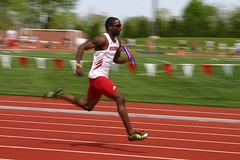
Two studies that say how best to recover from repeated sprints....basically rest / passive recovery rather than active recovery.
Effect of Recovery Mode on Repeated Sprint Ability in Young Basketball Players. - The results of this study show that during repeated sprinting, passive recovery enabled better performance, reducing fatigue. Consequently, the use of passive recovery is advisable during competition in order to limit fatigue as a consequence of repeated high intensity exercise.
Performance and metabolism in repeated sprint exercise: effect of recovery intensity - In summary, peak power indices during the repeated-sprint test were inferior in the MI (moderate intensity) and LI (low intensity) active recovery trials, compared to passive (total rest?) . The minimal differences in performance and muscle metabolites between the MI and LI trials suggest that any low-to-moderate level of muscle activation will attenuate the resynthesis of PCr and the recovery of power output during repeated short-sprint exercise.
Not sure how we apply this to sports - e.g. football where, while you may be doing repeated sprints, you cannot just stand around to recover...... UPDATE 1/5/08 - of course as someone comments below, that is the point. In such sports, you cannot recover passively. That is why conditionign is so important and why these studies msut always be put into some context.
Sunday, December 23, 2007
Sprint vs interval training for football (soccer)

 A little while I had a post up reporting a study that found that soccer was more effective for promoting fat loss than was jogging. I talked about soccer being a series of sprints / jogs / walks and speculated that it was this mix of intensities that was important - similar to Art DeVany's thoughts on the power law distribution - lots of easy stuff and a few hard bits randomly scattered in.
Here is another study looking at building training for soccer around sprints rather than long runs. In fact this study seems to indicate that repeated 40 metre sprints were more effective than longer intervals (4mins). It makes sense - football is about sprints, that do not usually go on longer than 40 metres. You don't run continually for 4 minutes in a game, so why train like that?
Sprint vs. Interval Training in Football.
The aim of this study was to compare the effects of high-intensity aerobic interval and repeated-sprint ability (RSA) training on aerobic and anaerobic physiological variables in male football players.
Forty-two participants were randomly assigned to either the interval training group (ITG, 4 x 4 min running at 90 - 95 % of HR (max); n = 21) or repeated-sprint training group (RSG, 3 x 6 maximal shuttle sprints of 40 m; n = 21).
The following outcomes were measured at baseline and after 7 weeks of training: maximum oxygen uptake, respiratory compensation point, football-specific endurance (Yo-Yo Intermittent Recovery Test, YYIRT), 10-m sprint time, jump height and power, and RSA. Significant group x time interaction was found for YYIRT (p = 0.003) with RSG showing greater improvement (from 1917 +/- 439 to 2455 +/- 488 m) than ITG (from 1846 +/- 329 to 2077 +/- 300 m).
Similarly, a significant interaction was found in RSA mean time (p = 0.006) with only the RSG group showing an improvement after training (from 7.53 +/- 0.21 to 7.37 +/- 0.17 s). No other group x time interactions were found. Significant pre-post changes were found for absolute and relative maximum oxygen uptake and respiratory compensation point (p < 0.05). These findings suggest that the RSA training protocol used in this study can be an effective training strategy for inducing aerobic and football-specific training adaptations.
Tuesday, October 30, 2007
Indoor Rowing - Concept 2: World Record for 500m
I came across this video on the Crossfit Central Scotland site. I really like Crossfit CS. These aren't the chiselled Californian superhero crossfitters that you see in the videos from CS HQ. These guys look like normal people....plus they are from Motherwell, which is about as down to earth as it gets.
Anyway, this is an inspiring video of a 500m world record on the rower. If you have ever tried it you will know how hard this is. The 500m distance is a real challenge. It is further than a sprint, but no so far that you can settle into it.
Smooth and powerful.
Anyway, this is an inspiring video of a 500m world record on the rower. If you have ever tried it you will know how hard this is. The 500m distance is a real challenge. It is further than a sprint, but no so far that you can settle into it.
Smooth and powerful.
Tuesday, October 9, 2007
More Interval Sprinting.....
We often talk here about interval work and sprinting.
Art DeVany recently said:
If you could only do one thing for your body
here is video of Mark Sisson showing what we are talking about
Art DeVany recently said:
If you could only do one thing for your body
You should sprint for your exercise. It is fun, builds coordination, and will make you stronger and leaner. The damage to your joints is far less than jogging and it is more effective than walking. Sprinting trains anaerobic and aerobic pathways, but with less oxydative load than jogging.
Interval sprints, mixed with walking are my favorite way to make my "come backs" when I have been traveling or busy. Even when my joints get a bit sore from working out. Yes, I have reached the age where I sometimes have joint soreness from working out. I find there is no better way to ease the load on the joints and come back to the gym with fresh energy than to sprint and walk.
here is video of Mark Sisson showing what we are talking about
Sunday, September 16, 2007
Too tired to workout? Take a nap!
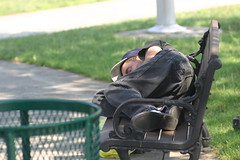
This study looked at how a short nap after lunch improved the alertness and physical performance of people who were mildly sleep deprived. If you are short of sleep, through overwork, kids or whatever, a nap after lunch could be a good idea if you still want to work and work out well.
And you do not even have to sleep - the participants in the study either slept or just sat quietly for 30 minutes.
The role of a short post-lunch nap in improving cognitive, motor, and sprint performance in participants with partial sleep deprivation.
The aim of this study was to determine the effects of a post-lunch nap on subjective alertness and performance following partial sleep loss. Ten healthy males (mean age 23.3 years, s = 3.4) either napped or sat quietly from 13:00 to 13:30 h after a night of shortened sleep (sleep 23:00 - 03:00 h only). Thirty minutes after the afternoon nap or control (no-nap) condition, alertness, short-term memory, intra-aural temperature, heart rate, choice reaction time, grip strength, and times for 2-m and 20-m sprints were recorded. The afternoon nap lowered heart rate and intra-aural temperature. Alertness, sleepiness, short-term memory, and accuracy at the 8-choice reaction time test were improved by napping (P < 0.05), but mean reaction times and grip strength were not affected (P > 0.05). Sprint times were improved. Mean time for the 2-m sprints fell from 1.060 s (s(x) = 0.018) to 1.019 s (s(x) = 0.019) (P = 0.031 paired t-test); mean time for the 20-m sprints fell from 3.971 s (s(x) = 0.054) to 3.878 s (s(x) = 0.047) (P = 0.013). These results indicate that a post-lunch nap improves alertness and aspects of mental and physical performance following partial sleep loss, and have implications for athletes with restricted sleep during training or before competition.
Subscribe to:
Posts (Atom)