Showing posts with label HIT. Show all posts

Thursday, May 31, 2012

Resistance Training improves Cardio Fitness....Get Strong to get fit!

So we have been saying this for a while.... One of the key themes of my book Hillfit is that getting stronger will make you more fit for "cardio" activities such as hillwalking or hiking.  The theme is how to get stronger.  Indeed I had one client ask for a refund because I didn't tell her how to improve her cardiovascular fitness!  I need to send her this new paper:

Resistance Training to Momentary Muscular Failure Improves Cardiovascular Fitness in Humans: A Review of Acute Physiological Responses and Chronic Physiological Adaptations

A detailed, peer reviewed academic survey of the literature and previous studies which demonstrates that proper resistance training...to failure...improves all the standard measures of cardiovascular fitness.

This is a proper scientific paper, long and in depth.  The writers have been through all the relevant previous work on this and have demonstrated that getting stronger gets you fitter!

The full paper is available on line and  I have put the abstract below.

Training to Momentary Muscular Failure Improves Cardiovascular Fitness in Humans: A Review of Acute Physiological Responses and Chronic Physiological Adaptations. JEPonline 2012;15(3):53- 80. Research demonstrates resistance training produces significant improvement in cardiovascular fitness (VO2 max, economy of movement). To date no review article has considered the underlying physiological mechanisms that might support such improvements. This article is a comprehensive, systematic narrative review of the literature surrounding the area of resistance training, cardiovascular fitness and the acute responses and chronic adaptations it produces. The primary concern with existing research is the lack of clarity and inappropriate quantification of resistance training intensity. Thus, an important consideration of this review is the effect of intensity. The acute metabolic and molecular responses to resistance training to momentary muscular failure do not differ from that of traditional endurance training. Myocardial function appears to be maintained, perhaps enhanced, in acute response to high intensity resistance training, and contraction intensity appears to mediate the acute vascular response to resistance training. The results of chronic physiological adaptations demonstrate that resistance training to momentary muscular failure produces a number of physiological adaptations, which may facilitate the observed improvements in cardiovascular fitness. The adaptations may include an increase in mitochondrial enzymes, mitochondrial proliferation, phenotypic conversion from type IIx towards type IIa muscle fibers, and vascular remodeling (including capillarization). Resistance training to momentary muscular failure causes sufficient acute stimuli to produce chronic physiological adaptations that enhance cardiovascular fitness. This review appears to be the first to present this conclusion and, therefore, it may help stimulate a changing paradigm addressing the misnomer of ‘cardiovascular’ exercise as being determined by modality.
Key Words: Aerobic, Metabolic, Molecular, Myocardial

Go and read it....it will challenge you but will also explain a lot of where I am coming from in this blog and in Hillfit.   James Steele, the lead author, writes about the paper on his excellent blog - No such thing as cardio

Monday, January 9, 2012

Functional training...still a myth

I've had lots of stuff on here over the years calling into question the idea of functional training.  There is no skill transfer from one movement to another.  Movement skills are very specific and when you change the movement you need to develop new skills.  For example in tennis using a heavier racquet would not make you able to hit harder when you switch to a ligher one  -  it is a different skill.  You would have to learn all over again how to move with the different implement.  We covered some of this in the interviews with Luke Carlson, Drew Baye and Doug McGuff.

Anyway, James Steele today pointed to a new paper that addresses all this stuff


Influence of dynamic versus static core exercises on performance in field based fitness tests.


It is worth reading the abstract that James copies.  He concludes:

As always, separate physical conditioning from skill conditioning.

Saturday, December 31, 2011

The Renaissance of Exercise

Well the book arrived while I was away for Christmas.   I've been reading the Renaissance Exercise blog for a while now, following the interest sparked on the Body By Science forum.  The protocol and indeed the whole philosophy of Renaissance Exercise interested me very much partly because it made sense - it lines up with the position of writers that I have leaned a lot form such as Doug McGuff and Drew Baye - and partly because it appealed to my contrarian leanings.

I'd read a fair amount of the SuperSlow articles that were freely available on the internet - there are several here - so I knew roughly what I was getting into.  Renaissance Exercise's marketing strategy was to drip feed blog posts, generating interest and then to launch their machines at a major event following up with the book itself. Well it worked for me, and I ordered the book.  The price put me off initially but I viewed it as a text book / investment and went for it.  I emailed Drew Baye as well and he highly recommended it and he always comes across as a harsh critic.

320 pages, hardback, ribbon bookmarks, dense with information.  This will be an interesting read.  You can find more on the book here

Wednesday, December 14, 2011

The bodyweight option.....

You will recall that in the past I have interviewed the authors of Body By Science - Doug McGuff and John Little.

Over on Mark Sisson's blog Doug has a guest post on the Body By Science approach to exercise - Setting Yourself Up to Win: A Body By Science Approach

It is a good introduction to the principles of proper exercise, but the reason I am posting this here is jsut to draw attention to his bodyweight training option.  I hoep Mark and Doug do not mind me copying it here:

If you cannot go to a commercial gym, you can get started with simple free-hand exercises that I will describe to you now.


Chin up: This can be done with a chin-up bar that mounts in a door jam, on a sturdy tree branch or rafter board or playground equipment. If you are not strong enough to do chins, you can set the bar height so you can assist with your legs. If this will not work, simply do them negative only by jumping or climbing to the finished position and lowering yourself as slowly as possible.


Pushups: If you are too weak to perform strict marine pushups, do them from your knees. If you are too weak to do them from your knees, then do only the lowering portion, lowering as slowly as possible. If you are strong enough to do classic pushups, do them with a few modifications. First is slow movement. Start the first inch very gradually, taking 3 seconds to move the first inch and then keep smooth movement going. Divide the movement in halves. Do the first half (bottom position to elbows bent at 90 degrees) until complete fatigue. After you have exhausted the bottom half, do the top half until complete fatigue (elbows from 90 degrees to almost complete extension).


Squat: Start first by doing a static wall squat. Place your back against a wall and descend to a seated position where your hip joint and knee joint are both at 90 degrees. Hold this position for as long as possible. You are done when you start to slide down and cannot hold the 90 degree position any longer. Once you are worn out on the static, do a deep knee bend but with the movement divided in half. Do the first half until fatigue (from hips and knees at 90 degrees/thighs parallel to floor, up to the halfway up point where knees are about 45 degrees). Once you canʼt do the bottom half any more, then do the top half of the movement until you canʼt go on. Remember to not straighten your legs completely, but to turn back around when your knees get to about 15 degrees.


Static Lateral Raise: This movement is done using a door frame. Stand with your feet just outside the door frame and bend slightly forward at the waist. Place the backs of your open hands in the opening of the door frame with your elbows slightly bent. You should be positioned like you are going to a lateral raise with dumbbells. With your hands in the door frame, begin to slowly and smoothly press laterally against the frame. Gradually build up to a 50% effort and keep up a 50% effort for 30 seconds. After 30 seconds, gradually ramp your effort up to 75% effort and continue for another 30 seconds. After this 30 seconds is up, gradually ramp your effort to 100% and continue for a final 30 seconds. When you first start you will think “this is silly”. However, by the end you will realize that this is probably tougher than anything you could do on a weight machine.
The timed static contraction for the lateral raise at the end is a killer.  Superb stuff.

Monday, December 5, 2011

Minimal Fitness 2

I mentioned this study a few days ago, but I was away from my computer so couldn't write much.

The study is here.

Towards the minimal amount of exercise for improving metabolic health: beneficial effects of reduced-exertion high-intensity interval training.

It was done here in Edinburgh at Heriot-Watt University.  The protocol that was tested was of 3 easy 10 minute cycling sessions with a one or two hard 10 second sprints thrown in.  The result was an improvement in key health markers - insulin sensitivity and VO2 peak.

The researchers see this as a great encouragement -  big benefits can come from relatively modest investments in time:

In conclusion, in this study we have shown that a very brief and feasible exercise intervention is associated with improvements in metabolic health and aerobic capacity. Our findings suggest that this REHIT protocol may offer a genuinely time-efficient alternative to HIT and conven- tional cardiorespiratory exercise training for improving risk factors of T2D.
 I also think that this is an exciting study with some very exciting implications.  All this of course chimes with the work of Tabata, Termblay and Gibala over recent years.  Just a few bullets:

  • Again it is about intensity -  those hard 10 second efforts do the job.
  • This does not take long -  there should be no excuse that you have no time to exercise.

Alex at the superb Sweat Science blog has already looked at this research and commented that this will not really get people off the couch and onto the exercise bike.  He is probably right.

The way in which I view this is obviously different from the way in which a non exercising unfit person would consider the research.  To me it is a motivation and an encouragement - if I am taking a short walk I discover that a short sprint up some stairs will have a good impact - it will make me more insulin sensitive for example. 

I want to use things like this to get people to do some intense movement.  Not much, but something challenging.

Of course, at the back of this as an HIT enthusiast, I always wonder whether all the benefits could also come from appropriate resistance training......

Thursday, September 1, 2011

Wisdom from Clarence Bass

Clarence has been around for such a long time that I sort of assume that everyone knows of him and - like me - waits each month for his site update.  But I've found that lots of people still are not aware of him.

He has a couple of good posts this month:

Intensity, Failure, Rep Range, Muscular Endurance, Specificity  - A review of James Steele II article that I pointed to a while ago
A nice piece on cross training -   Cross-Training Doesn’t Work—Unless it’s Weight Training


Sunday, February 13, 2011

It can take at least 6 days to recover from a hard training session

This study seems to support the basic workout frequency prescribed by Doug McGuff and John Little in Body by Science - once a week (and less frequently if necessary).

Recovery after Heavy Resistance Exercise And Skeletal Muscle Androgen Receptor And Insulin-Like Growth Factor-I Isoform Expression In Strength Trained Men.

The effects of heavy resistance exercise on skeletal muscle androgen receptor (AR) protein concentration and mRNAs of AR, insulin-like growth factor-I (IGF)-IEa, and mechano growth factor (MGF) expression were examined from biopsies of vastus lateralis (VL) muscle before and 48 hours after heavy resistance exercise (5 × 10 repetition maximum [RM] leg press and 4 × 10RM squats) in 8 adult strength trained men. The present exercise induced an acute decrease in maximal isometric force and increased serum total testosterone (T) and free testosterone (FT) concentrations. During 2 recovery days, maximal isometric force and subjective perception of physical fitness remained significantly lowered, whereas serum creatine kinase activity, subjective muscle soreness, and muscle swelling (i.e., thickness of VL by ultrasound) were significantly increased compared to pre-exercise values. Subjective perception of physical fitness was followed up to 7 days, and by 6 days postexercise, it was elevated above the pre-exercise level. Basal T and FT concentrations remained unaltered after the exercise. No statistically significant changes were observed in AR protein or mRNA expression, but IGF-IEa (p < 0.05) and MGF (p < 0.05) mRNA expression were increased compared to pre-exercise levels. These findings indicate that IGF-IEa and MGF responses may be related to acute regenerative processes in muscle because of exercise and may contribute to muscular adaptation to resistance exercise. Subjective perception of physical fitness suggests that recovery over a pre-exercise level of the present type of heavy resistance exercise can take approximately 6 days.


Of course I am left asking about the vaidity of subjective perceptions.....

Friday, January 7, 2011

Pushups as a skill......

Gus Diamantopoulos has a fascinating post at Renaissance Exercise.   He touches on a lot of things but manly at the end he is talking about how you there is a great skill element even in basic bodyweight exercises: the pushup, squat and chin.  As such high skill moves, the need for skill can often get in the way of the exercise and the "inroad" of the muscles - i.e., form breaks down befor the muscles reach failure.

When you ask an instructor to show you how to push-up or squat, you’re asking him to show you how to perform upper level martial arts, or how to play music on a new  instrument, or how to ride a motorcycle. These are not activities that one can learn quickly.
They require study, theory, practice, and ongoing, repeated practice. This will be sobering and perhaps even disheartening to some but to suggest otherwise is not only overly optimistic, it’s downright irresponsible.

Having said this, I do believe that the burden of such skills is not insurmountable, especially for the truly motivated and disciplined subject.

 My suggestion for anyone who wishes to apply our most general principles to basic and conventional movements is to practice a small number of basic exercises well and often.  Research proper performance of these basics in books and online.  Make every effort to execute your movements with focused precision and intent.  Record your performances using video and watch for every possible discrepancy and continue to practice. Practice in the early stages should trump ambitions for intensity (i.e., muscular failure and deep inroad).
Only when you’ve practiced sufficiently and over-learned these activities can a program of free squats, push-ups and chin-ups be productive and effective. 

It is worth reading through and ties in to some of my recent thought in recent posts, where I have been musing on the development of strength and the separate development of skill.  The video from Doug here and the  work of Erwan Le Corre  have also contributed. 


(Obviosuly you should go slower than this....and the guys neck should not be extended like that....)

Wednesday, December 8, 2010

Doug McGuff lecture

Anthony has posted part of a lecture from Doug McGuff

Doug sums it up -  "don't overtrain....and eat like Mark Sisson told you."

Saturday, November 20, 2010

Patrick Diver - interview with an intelligent, strong, paleo cyclist!

I first came across Patrick Diver via the Body By Science Blog where he was commenting regularly and posting some videos of his training.  I was intrigued at a high level endurance athlete training with  short HIT style sessions.  That led to this interview.  I hope you enjoy it and get as much from it as I have.  There is some great material in here!

Patrick, normally in these interviews I start off by asking a little about your background: how you got into training and how you developed your particular approach.  Who are you?
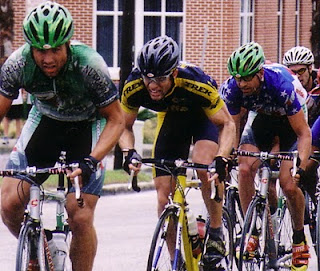
Pushing Hard on the bike


Hi Chris, my name is Patrick Diver and I’ve had a personal training business, Greyhound
Fitness, for nearly 9 years now in Orlando, Florida. I also have a couple other websites including patrickdiver.com and fitnessgod.com. 

The latter, funny URL and all, has a new weblog I just started (also to be found at patrickdiver.blogspot.com).  

As far as philosophy is concerned, first and foremost, I’m an advocate of strength training. 

I know I will be labeled a “HIT guy," but I got my start in strength training a decade or so before I had ever heard of Arthur Jones or high intensity training.  My father was a math teacher and coach at my high school, so the football coaches more or less took me under their wing and taught me how to strength train.  

Although, I didn't play football, I was allowed to strength train with the team.   Because I was scrawny, I knew that if I was going to fit it, I would have to train pretty hard.   I adopted a high intensity  approach -- going to muscular failure from the start.

Our facility was a hardcore, makeshift gym under the stairs of the football stadium.  We used free weights, some universal machines, for pull downs and rows, and had a couple chain driven Nautilus leg machines.  Not to over-romanticize the environment, but it was dark and damp and everything someone like Keith Norris would love; super hot during the summer months, with only big metal fans offering a smidgen of respite from the heat, and icy cold during the winter months.  I’m from the Midwest -- St. Louis -- so we dealt with both temperature extremes.

Toward the tail end of high school, I started road racing bicycles; my interest in strength training really blossomed out of my desire to improve my strength during the winter off season months.

Your website notes that you are certified in SuperSlow, Nautilus, have a BS in Sports Medicine and Athletic Training and have been a highly competitive cyclist.  Can you tell me how you discovered this style of training – lets call it "HIT"?


When I was looking at getting into personal training as a business I sought advice.  I learned one of the top cyclists in our area, Gary Anger, ran a highly successful personal training business.  At the time, I had just resumed bicycle racing after taking a number of years off. When I learned Gary ran a personal training business, I asked if we could meet. 
Gary was really the one who introduced me to the concept of high intensity training.  The first time we got together he brought me through a workout.  To this day, at least in my mind, it remains the hardest workout I have ever done.  I was no stranger to intensity – especially when you consider that bicycle racing is all about intensity -- but the purity of effort required for his workout was really shocking.  Following that workout, it took me a good 10 minutes to get off the floor.  

So from there on, I was completely intrigued.  I spent the next few months reading anything I could get my hands on from experts like Darden, Hutchins, McGuff, and others.  As important, though, was my own (n = 1) experience.  I began incorporating HIT workouts within the framework of my training for cycling.  About seven months from that first HIT workout I accomplished the goal I had set for myself: winning the Florida Pro I/II criterium championship.  To date, my win is one of 44 state titles on which Gary has his imprint.
 
In addition to HIT, Gary taught me the business of personal training.  For those who know him, Gary is every bit as influential in the HIT community as the other big names like Mentzer, Jones, and McGuff  – he just keeps a lower profile.

Did you find Superslow / Nautilus / HIT consistent with the principles you were taught at university?
 
No, most of what I was taught in school revolved around “functional” exercises and therapeutic modalities.  The modalities have a role in the reduction of pain and inflammation, but the use of “functional” exercises instead of progressive strength based protocols is a therapeutic 'misstep' in my opinion.
 
The fact that I didn’t learn about Arthur Jones or his contributions to the strength and rehabilitation communities through his work with Nautilus Sports/Medical and MedX, speaks volumes.  Even a HIT cynic would have a hard time completely dismissing his body of work, especially with regard to low back rehabilitation.

At the very least, I think Nautilus Bulletin #1 and #2, as well as Ken’s SuperSlow Technical Manual should be required reading. When I was in school (graduated in 1995), strength training was barely covered, while the use of isokinetic machines, wobble boards, total gyms (!), and slide boards was the norm. And I went to a school (Southwest Missouri State, now just Missouri State) with very good instructors and a highly respected sports medicine and athletic training program. But we all know how it goes: instructors simply pass down what they have been taught themselves; most probably had no clue who Arthur Jones was either.

In my mind, physical rehab comes down to two things: reducing pain/inflammation and improving strength.  So for strength training not to be given due diligence is another  therapeutic ‘misstep.’ Furthermore, for it not to be the focus  of exercise physiology classes is somewhat mind blowing.  What is more important than maintaining strength and muscle mass as a person grows older?

Do you still ride the bike competitively?
Killer Triceps!


I have an on-again/off-again affair with the bicycle.  After I won the state championship I raced another half season and then took the next 7 years off.  This past May, I purchased a new bike and started training again -- well, if you can call it that -- my first group ride was a race I entered an hour after picking up my bike from the shop.  The amazing thing is right away I felt like I had never stopped; I was completely comfortable.  Unfortunately that feeling lasted about 60 seconds before reality sunk in and I was given a beat down.  Although my leg strength was high, in HIT vernacular, my skill conditioning was non-existent.  

What are the key factors of importance in training athletes? 


When it comes to building strength and metabolic fitness, I would say the most important thing is to motivate athletes to train hard.  It may seem obvious, but many athletes don’t train that hard. 

They are so skilled at their sport that they have never really put forth maximum effort in the gym.  Of course, they all think they are working hard, but I’m talking about really putting forth 100% effort. A good trainer can differentiate between someone giving maximum effort and someone huffing and puffing and creating all this commotion; but not really getting it done.  I’ve found that the stopwatch and workout card don’t lie -- if you’re 30 seconds down from your previous effort something is wrong: it could be recovery or it could be lack of  focus/effort.  

If you’ve read some of my previous interviews you might have noticed that an area that I am particularly interested in is the idea of “functional or so called sport specific training.  Do I take it that you agree with Doug McGuff, John Little and Luke Carlson who explained in their interviews that such an approach is, at best, misguided?  You need to strengthen the muscles in the most appropriate effective and efficient way…..and then learn the skills to apply that strength.
 
I completely agree with them.  Some athletes may put forth lackluster gym efforts (as mentioned above) partially because their energy resources are overtaxed.  When their strength and conditioning coach and head coach want to do conditioning drills, it may be too much.  The athlete may be constantly running at 80% or predisposed to injuries.  The coaches are then left scratching their heads wondering why their team lacked punch in the 4th quarter or why so many key players are out with injuries. 
 
In my opinion, a superior approach is to separate the two completely. A focused high intensity strength training protocol can produce similar or better strength gains while not monopolizing time or recovery resources better used practicing or resting.
It’s really pretty simple!


How would this apply to endurance activities such as cycling, where the mainstream trainers focus so much on so-called cardio – developing VO2 max etc?
 
The strength training is just an adjunct to all of the work being done on the bike.  The key is to balance the two so the strength work doesn’t interfere with the gains being made on the bike.  Good record keeping and listening to the athlete will help determine this balance. For most, a single strength training session lasting about 10 minutes every week or so is probably ideal.  Of course, this may need to be adjusted based on the athlete’s particular schedule.
 
Can HIT prepare you for competing in endurance sport?
 

Strengthening an athlete will only help their sports performance and buffer their resistance to injury.  HIT is great for this, but it does not replace sport specific endurance training. In fact, the overwhelming majority of clock time for the endurance athlete will be spent doing intervals and other sport specific training routines.
 
As an example, most cycling training manuals advocate strength training during the off-season. My call for once weekly HIT sessions should result in higher strength levels to be enjoyed season long, not just in the off-season.

Furthermore, I think coaches would be wise to look at all aspects of their traditional training programs and possibly cut back or weed out things that may be unnecessary, redundant, or done simply because "it's always been done that way." 

When I resumed cycling this past year, I didn't bother laying down a bunch of "base miles," even though every training manual would call for it -- especially after such a long layoff.  Instead, knowing my races (Pro I/II criteriums) generally last between 1-1.5 hours I concentrated on intervals, short and fast group rides, and training races.  The result?  Within 6 weeks I had finished a Pro I/II race in the pack, and by season end I was back at the front contesting race finishes.

A typical week would look like this:

  • Monday:   Off
  • Tuesday:  Intervals on bike + short HIT session
  • Wednesday:  Training Race
  • Thursday: Off
  • Friday: Off
  • Saturday:  Race
  • Sunday:  2.5 hour fast group ride

Total weekly hours: 5-7

Should it?  Are endurance sports healthy?
 
Probably not -- although Dr.Kurt Harris reached this conclusion from a technical perspective, I have always had a hard time believing there was anything particularly healthy about blasting my heart rate for an hour and a half during one of my races.  

Of course, that says nothing of the potential long-term joint risk runners face...or in the case of cyclists, the very real possibility of being sideswiped by a car or truck.    

So no, I can’t imagine endurance sports are healthy.  That said, I wouldn’t necessarily discourage anyone from competing.  I race bicycles because a) I like to compete and b) my phenotype is somewhat designed to do well pedaling a bicycle (I say somewhat, because I am not in the same leagues as a professional like Andy Schleck or Phillipe Gilbert).  
 
If I was as big as Orlando’s Dwight Howard, I would be playing basketball.

At the end of the day, I think people should be aware of the inherent risks and then make up their own mind.  

I strongly disagree when a well meaning doctor or co-worker suggests someone take up an endurance sport to get in better shape.  I believe strength training is a much safer and beneficial choice.

Where do you stand with respect to diet?
 
I have had the most client success generally working within the paleo/ancestral dietary framework.  Clients eager to make changes adapt to it pretty well and the recidivism is generally pretty low.  Of course, not everybody is ready to make the necessary changes, but I keep spoon feeding clients articles, blog posts, podcasts, and books to educate them as much as possible.

I’m a fan of Mark Sisson’s The Primal Blueprint, as well as Nora Gedgaudas’s Primal Body, Primal Mind book (and podcasts).  Robb Wolf’s The Paleo Solution is perhaps my favorite book to introduce the paleo/ancestral nutritional concepts.  I also recommend his podcasts (seriously, any podcast able to work in commentary on the movie, Rad, receives an automatic thumbs up from me).     
Working with clients and food is quite challenging.  It many ways it resembles trying to put together a puzzle that may or may not be missing pieces.  The client really has to be committed and open to the idea that it may not be a quick fix.  For example, if there are thyroid/adrenal issues, sleep/recovery issues, or anxiety/depression issues it may take awhile to uncover potential weight loss road blocks.

I am also open to new ideas as well as opposing views.  Recently, I’ve been experimenting with Martin Berkhan's Lean Gains approach and find it very interesting. From my observation, many naturally lean people tend to naturally swing to an IF approach.

From an athletic viewpoint, I maintained a relativel low carb, mid protein, and high fat diet this past cycling season.  Since I had been eating that way prior to getting back into cycling, I really didn't notice much difference -- although I did up my carb intake a little bit, usually in the form of white rice.  I would say my experience echoed what Jamie Scott wrote about in his excellent High Fat Diet for Cyclists series.

Do you think those of us with an interest in training – even or especially HIT type people – spend too much time obsessing over their training, reading the blogs and forums, analysing the details not the principles?


Some do perhaps.  Personally, I am intrigued by the details but know none of it matters without possessing a solid exercise foundation.  In my mind that foundation consists of two things: exercise intensity and consistency. 

I still think sometimes that I am looking for the magic routine!  I noticed that when John Little introduced his Max Pyramid Protocol – we all jumped on it like it was the secret to success for a while.


Of course, that is only natural -- especially for enthusiasts or those engaged in their own n = 1 experimentation.  To expand on what I said above, however, my personal n =1 includes:

  1. Have trained once, twice, and three times a week.
  2. Have used free weights, Nautilus (3 or 4 versions including retro-fitted SS cams), Superslow Systems (including the Linear Spine), MedX, Cybex, and many others.
  3. Have used many protocols including traditional Superslow, 5/5, 3/3, on-counting, single sets, multiple sets, supersets, rest pause, pyramids, time static contractions and deep inroad techniques. 

    Personally, none of this stuff made much of a difference with me.  Record keeping shows I achieved the same results training once a week as three times a week.  Records also show whether I used free weights, machines, or fancy in-roading techniques, the results were the same.  If I have a preference for machines it comes from a practicality and safety standpoint. 


    Again, the most important factors still come down to the desire and ability to train with great intensity and consistency.  In fact, since high school, there has not been a period longer than 3 months where I have not worked out on a regular basis. 

    So as Fred Fornicola mentioned in his interview each of these protocols represent additional "tools in the toolbox," but none of them will make up for poor or inconsistent effort.

    In my opinion, if you keep to the basics of exercise intensity and consistency and place your remaining focus on getting your diet and sleep schedule nailed, you will see your best results. 


    Why is there so much hate directed towards High Intensity Training?  After I posted my interviews of Doug McGuff and John Little I saw my blog get described on one forum as “HIT cock sucking”….


    It reminds me of the famous quote from Bill Cosby, "I don't know the key to success, but the key to failure is trying to please everyone all the time."

    There are some people that are just not ever going to be on board with HIT.  I'm perfectly okay with their choice.  The reality is for many people physical training represents something much greater than improving their physical condition.  The gym, particularly for people in their 20's, can be a home away from home, a social club, or a simply a place to hang out.  So if someone comes along and challenges their perception of exercise and says, "Hey, there is no reason to hang out in the gym all day," it is understood that they might get defensive.


    There is no doubt the tone of some of the more prominent HIT authors like Jones and Hutchins turns some people off. Someone like McGuff represents the antithetical approach, but even he gets attacked.

    Like I said, I'm not really interested in converting any of these anonymous internet types.  Nor am I going to argue with a power lifter at the gym.  I have over 10 years of experience working out in those environments, know firsthand what it is like, and can even appreciate
    it for what it is.

    For now though, there are enough people that need and appreciate my brand of strength training for me to focus on.   


    One thing that I notice with HIT style training is that is all seems very serious! This catches me a little.  Those into “functional training” look like they are having fun  (e.g. the MovNat guy)!  Movement, skill based movement, is often just joyous!  Jumping rolling, fighting, climbing.  How do we balance the need for proper training with the fact that movement is fun and exciting! 


    HIT purists, especially those waving the Superslow flag, would argue that exercise is not supposed to be fun, and that everything under the "functional training" umbrella is better classified as "recreation." To really understand this argument it helps to have a read the chapter on Exercise versus Recreation in the Superslow technical manual.   

    To summarize:  many activities that are commonly  labelled "exercise," say cycling, for example, do not provide the stimulation needed to result in an enhancement of total body conditioning. 

    Of course, arguments like those end up pissing off a lot of cyclists or whoever that say, "How dare you say I am not exercising!"

    My take on it goes like this:  do a HIT session once a week to cover your bases, and then go jump, roll, fight, climb, cycle or whatever else that seems like fun to you. 


    Do you see a role for prehab  / rehab exercises?  For example If you read the blogs of some trainers they make much of shoulder work (YWLT moves, face pulls, external rotation work, stretching  etc.)  Others go into detail on joint mobility as a panacea for all sorts of problems.   Is this just a diversion or is there a point to it?


    It all depends on if these trainers are getting results. 

    Even then it's difficult to determine if the improvement in mobility or pain relief is resultant of the exercises, a reduction in activity, or some other factor.   

    A cyclist's tan


    I am constantly working with clients with shoulder, knee, or other joint issues so I am open to learning new techniques and strategies, but believe an appreciation of the basics -- knowing when to back off or reduce workload -- is sometimes just as important. 


    Much of my training is often done at home – commercial gyms are not convenient and it is often difficult  to get a decent session in with people hogging  machines or chatting.  All I really have at home are dumbbells.   What scope is there for training productively with only callisthenics and dumbbells? (Recently I’ve been experimenting with static contractions)


    With Moment Arm Exercise by Bill DeSimone and Fred Fornicola's book, Dumbbell Training for Strength and Fitness, amongst others, there is no shortage of great resources available to home workout enthusiasts.

    That said, information is often not the limiting factor -- but a lack of commitment and consistency.  I am all for people doing what works best for them as long as it represents something they can do with long term consistency. 
     
    For some people that means working out by themselves at home, whereas others simply won't do it unless they have a personal trainer standing over them.  

    The key is to figure out which category you fall under!

    Finally, I know that there are a lot of people who read this blog who are not particularly gifted athletes – just average guys with jobs, worries and family responsibilities.  What are the key things that they need to know as they try to integrate some training into their busy lives?


    The majority of my clients fall under this category -- just average men or women with stressful jobs, worries, and family responsibilities.  The time advantage of HIT is generally what attracts them. I have clients that have been with me 6-8 years because they know they can come in once or twice a week, blast out a workout, and be on with their lives.  

    For years I have been trumpeting the benefits of this exercise approach because most people cite 'lack of time' as their biggest reason for not being in shape.  Well here you go; problem solved.  What is surprising to me is why some of the big box gyms don't offer HIT programs alongside their menu of programs like spin classes, kickboxing, and regular personal training.  The market is there, it just needs to be cultivated.

    In summary, though, the key for most people is to figure out a program that can fit in their schedule -- even if it's just once a week -- and  make the mental  commitment to stick with it. 

    From there it is simply a matter of one thing, which coincidentally just happens to be the title of my first blog post: Do it.  

    There is no other way.


    Patrick - thanks so much for taking the time to do this interview and for putting so much time into drafting some very full responses to my questions.  There is some excellent material in here.  All the best for your future training and business.

    Wednesday, August 11, 2010

    It is about muscle fatigue

    Here is an interesting report, for those of us with an interest in High Intensity Training (HIT).

    Building muscle doesn't require lifting heavy weights: study

    "Rather than grunting and straining to lift heavy weights, you can grab something much lighter but you have to lift it until you can't lift it anymore," says Stuart Phillips, associate professor of kinesiology at McMaster University. "We're convinced that growing muscle means stimulating your muscle to make new muscle proteins, a process in the body that over time accumulates into bigger muscles."
    The report points to a recent study:

    Low-Load High Volume Resistance Exercise Stimulates Muscle Protein Synthesis More Than High-Load Low Volume Resistance Exercise in Young Men


    The study used light weights that represented a percentage of what the subjects could lift. The heavier weights were set to 90% of a person's best lift and the light weights at a mere 30% of what people could lift. "It's a very light weight," says Phillips noting that the 90-80% range is usually something people can lift from 5-10 times before fatigue sets in. At 30%, Burd reported that subjects could lift that weight at least 24 times before they felt fatigue.

    "We're excited to see where this new paradigm will lead," says Phillips, adding that these new data have practical significance for gym enthusiasts but more importantly for people with compromised skeletal muscle mass, such as the elderly, patients with cancer, or those who are recovering from trauma, surgery or even stroke.


    It reminds me of Clarence Bass recent reports that the important thing is effort - Forget Heavy, Think Effort - which Matt discussed here, following up here and here. (incidentally the final link actually points to the original study I started with above).

    Sunday, July 25, 2010

    Interview - Fred Fornicola

    Here is another interview, this time with Fred Fornicola, owner of Premiere Personal Fitness and co-author of Dumbbell Training for Strength And Fitness an excellent little book.

    Fred, I first came across you due to your book on dumbbell training and then seeing you as a regular commenter on the Body by Science blog, but can you give my readers a short introduction to yourself? Who are you and what is your background in exercise?


    Well Chris, my name is Fred Fornicola and I’ve been involved in training and fitness since I was about 15. I own and operate Premiere Personal Fitness in Asbury Park, New Jersey (Chris - there is a video of the gym here) . I’m a fitness professional, personal trainer, strength and conditioning coach, fitness consultant, lifestyle fitness coach, as well as a published author. I’ve been involved in the field of strength and fitness for over 34 years. I was one of the contributing authors of the book Get Fit New Jersey! and co-authored the best-selling book “Dumbbell Training for Strength and Fitness”. My latest book is entitled “Youth Fitness: An Action Plan for Shaping America’s Kids” which I also co-authored with Matt Brzycki.


    What led you to write the book on Dumbbell Training? (An excellent book by the way that I would recommend to anyone)

    Matt Brzycki and I have been friends for years and we spoke often about collaborating on a book project that was different from most of the other books out on store shelves. We did some homework and found that at that time, (fall of 2005) there were very few books on dumbbell training and if there were any, they didn’t go into any great detail. We felt this was a great opportunity to produce a book that was concise and informative and we decided to narrow our focus and rolled the dice.


    Are you happy with how the book turned out?

    Yes, we’re very pleased with the book and its sales performance (to date we have sold over 15,000 copies). We put a lot of time not only into the information that’s found in the book but in the layout and marketing of it. I came up with its format by stealing the idea of how cookbooks are normally structured.

    Cookbooks generally offer cooking information and insights with descriptions and photos and then supply recipes to compliment what was written. We did something similar by providing what we feel is safe, efficient and effective material along with text and visual instruction. The “recipes”, if you will, are the 40 plus workouts which were obtained by strength coaches and trainers from across the country. Some of our more familiar contributors are Dr. Ken Leistner, Coach Ken Mannie of MSU and NFL strength coach, Jeff Friday. The book is also small in size (5” x 8”) so it can easily be put in a gym bag or carried to use when working out if a person needs a new workout or wants to double check how an exercise is performed.


    In the photos in the book to illustrate the exercises, you have featured “normal” people with achievable physiques. Was this a conscious decision? I get annoyed at books illustrated with bodybuilders who obviously use drugs and would look good however they trained.

    Let’s face it Chris, most of the people in the book are average looking individuals and for a good reason, because most people don’t look like the super lean, genetically gifted individuals that are pranced around on most magazines and book covers. So yes, it was a conscious decision but in truth, these were just clients and friends that work hard at training and allow nature to take care of the rest.


    I particularly enjoyed the second chapter of the book – Get Strong and Fit – where you focus on some really important basic principles such as safety and also destroy some popular myths. How did your thinking in this chapter develop? What influenced you?

    The “Get Strong and Fit” chapter is just an ongoing philosophy of what Matt and I preach. We believe that safety is priority number one and so the chapter was merely an extension of what we teach. In fact, it was a simple chapter to write.


    One of the issues you raise is “explosiveness”. You address the common dogma that you need to train explosively to become explosive. The error in this approach is something that I’ve raise before on this blog. Why do you think this doctrine is so popular?

    Explosiveness is confused by many coaches and athletes in my opinion. To become explosive, you need to be strong, you need to be well conditioned for your sport/activity. Lifting fast or explosively creates momentum. If you use momentum, you aren’t forcing the muscles to do much of the work. Take for example the classic bench press. Most people accelerate in the beginning of the movement (usually with some additional “body English” or bounce) and as the weight reaches the peak of its movement the joints snap into place to stop that momentum at which time the resistance is quickly dropped and good old gravity kicks in and again, no muscle stimulation. What you are doing, however, is creating an environment which enhances injury due to the excessive forces on the joints and soft tissue while minimizing muscle involvement.

    A classic example of displaying strength instead of a focus on building strength. Ask an explosive lifter if he’d prefer to be handed a 25 pound dumbbell or would he rather it thrown at him. I can almost guarantee his answer will be “handed” due to his lack of desire to get injured by the thrown dumbbell. Then why throw weights around when you’re lifting?


    An additional aspect that is vital to being explosive that is often overlooked is you need to be a student of your sport/activity. Take for comparison two individuals who play football. Each of these guys can do 10 reps with 250 pounds on the bench press, complete 12 chinups and squat 315 pounds for 20 repetitions. Both men exude a good level of strength and, if these weights and repetitions are reflective of a set performed to muscular failure and done in good form, these two guys would have quite a good level of conditioning as performing such tasks are very demanding on the cardiovascular system.

    Now here is the one differential – one of these guys plays football and understands the sport quite well while the other has zero or little knowledge/experience of the game. Now who is going to be more explosive? It’s simple, the person who understands his sport will be more explosive because he knows what to expect and experience has taught him how and when to respond so he will be quicker, more responsive and therefore, more explosive.


    Similarly you address the problems with so called “functional” training and the related errors of thinking around sport specific training. (I interviewed Luke Carlson about this topic too). Again, why do you think that it is so hard for people to accept the ideas that you present?

    I don’t have a problem with sport specific training…just not in the weight room. I remember as a kid wearing a weight vest as a means of improving my ability to jump higher for basketball. I wore that vest for two straight weeks and played basketball as I normally did. At first my timing was off in my shooting but I adjusted after a couple of days. After two weeks I took it off and started playing ball again…the results? My jump shot was off as was my timing for jumping and getting rebounds. My body had gotten used to the additional weight and developed new skills – throwing my natural game off.


    I think working on strength and fitness safely and efficiently allows one to become functional. Functional, as I define it, is the ability to go out in life and…..drum roll please….be functional. Functioning in life means being able to do activities without becoming fatigued or injured so if that means riding a bike, gardening, swimming, taking out the trash, going for a hike, etc. you can “function” with a reduced risk of injury and not have to terminate a task because you are too weak or tired to perform it.


    I suppose your approach and philosophy lies firmly in the “High Intensity Training” (HIT) camp, although your book doesn’t really explicitly identify itself with that school. Was it a conscious decision not to label it an HIT book?

    My core belief and philosophy revolves around safety, efficiency and effectiveness, if that is one that falls into a high intensity training category, then that’s fine. I don’t refer to myself as a high intensity guy or any other category as I follow no dogma. I use whatever means I need to with those I work with so as to suit their physical, mental and emotional needs. Therefore, I am very open minded about how I train, using of course, my core beliefs. This too was the premise for writing the book.


    Whenever I feature any thing HIT on this blog I notice a lot of negativity – there is a lot of ill feeling and cynicism about this approach to training. Why do you think that is?

    Human nature, Chris. Try challenging someone about what they are doing and they will always defend themselves. Tell a republican about democratic views or a Christian about Muslim religion and they turn on a dime. The funny thing is, most people don’t realize we have more commonality than differences and that everyone can learn from each other. An open mind allows for much more information to be absorbed than one that is closed.

    I read, watch and listen to as much information as I can; I then evaluate, experiment and then decide from there if and how I will apply the information. But to directly answer your question, most people feel that high intensity training is a crock because they don’t understand the essence of training.


    I’ve been following HIT type ideas for years as I mentioned in my interview with John Little – his interview with Mentzer in a UK magazine in the mid 1980s still stands out in my memory. I’ve read lots of stuff over the years – Darden’s books (with their accompanying photos of steroid users), Slow Burn, John Little’s books, Body by Science.

    At its root this style of training is quite straightforward, but I often see in those of us that are interested in this approach something of a search for novelty – the new technique that will solve all our problems and finally make us grow. So we jump each new technique - max contraction, static holds, done in one, Superslow etc. Do you think there is a value in all these techniques or is there a danger that they are just distractions from a dedication to a basic routine mixed with patience and realistic expectations?
    Do I see value in these applications? Absolutely, they all have merit, but I don’t see these applications as anything other than another, as they say, “tool in the toolbox”. I feel these approaches have their place in one’s training and can be used in an infinite amount of ways – as long as they suit their needs.

    Training is personal and so the most straightforward advice I can tell a trainee is this; find the exercises and protocols that are safe, efficient and effective for you and use them. Some people like structure, some don’t, so who’s to say if changing and using different approaches is a distraction or an incentive for someone. I personally see no sense in having to follow some kind of dogma if you don’t enjoy yourself. If, for instance, SuperSlow was the very best way to train but I hated doing it, I wouldn’t use it. I think the real danger lies in not discovering things for yourself.

    Don’t worry if you’re following anyone else’s rules, it’s your body, it’s your workout – do whatever the hell you want. If you do multiple sets or don’t train to failure, you won’t get kicked out of the high intensity club. I’ve been told in the past I wasn’t allowed to do a particular exercise or protocol or some none high intensity approach because it wasn’t allowed….as if I need permission or some kind of sanction to train the way I want.


    In terms of workout frequency your book tends to recommend working out 2 or three times a week. That is quite frequent for HIT. How do you arrive at an appropriate frequency for training when you work with a client?

    When you work with individuals, you treat them like individuals and therefore you determine, from trial and error (along with many other factors) what works best for that individual. I have clients that train with me three times a week, twice a week and some only once per week. A lot depends on their abilities (mentally and physically) to help determine what works best for them.


    I enjoy training yet I know that – particularly as I get older – I need more rest between workouts. How do you think we should mange the paradox of wanting to train….yet knowing that not training will actually be beneficial in terms of recovery and improvement?

    Create a hierarchy or priority list of what your goals are. Understand what it is that will enable you to obtain your goal and before you do something, ask yourself if that what your about to do will contribute or detract you from achieving your goal. For instance, if your main focus is improving your leg press by 50 pounds, going out for a run a day or two before you train is not going to help you achieve your goal. Conversely, if you want to improve your 5k time, training your legs too frequently or intensely may prohibit you from getting you were you want to be.

    Maybe you are supposed to train tomorrow but you need to clear your mind so you take a hard bike ride and you feel better, so what’s the big deal if you take the next day or two off and then go lift. Basically, it boils down how you balance things with your training and life to achieve your desired goals.


    Do you make much use of bodyweight training with your clients?

    I go through my phases of training and will accentuate a modality or approach of training, but yes, I do implement bodyweight activities. I think they have great value for those that can perform them safely and intensely.


    Your book doesn’t say much about diet. Why is that?

    Chris, our main focus was to make it purely a book that was about training with dumbbells because we didn’t want to dilute its content. On our second collaboration “Youth Fitness: An Action Plan for Shaping America’s Kids” we expanded our information to cover the many aspects of health and fitness.


    Do you have a dietary approach that you support?

    Since I’m not a cookie-cutter kind of person, I have to say that I don’t have any single approach towards anything but with regards to diet, I lean towards more of a Mediterranean style diet. Now, that type of diet is not for everyone and therefore I have educated myself on many other aspects of dietary needs for specific groups. I am very fortunate to have a good friend, Tom Mantos who is extremely knowledgeable about nutrition and applications for special cases so I refer to him quite often for assistance.


    What does your own training look like at the moment? Have you implemented any new ideas recently?

    Chris, I experiment a lot and am structurally unstructured. If I wake up and feel like going for a run down at the beach on the sand, I do it. If I feel like training, I do it. If I just want to do one set of killer leg presses using a static routine, I do it. Basically, I do whatever, whenever, however and wherever I want as long as I keep safety in mind and enjoy the process. Currently, I am really finding the benefits of static training and have played around with a number of approaches and implementations of the protocol quite successfully.


    What is the most important lesson with respect to physical fitness that you have learned?

    Without a doubt, not resting enough when I knew I needed to. I’m not referring to a structure rest period or specific amount of days, I mean just not backing off when I knew I needed to. Pushing for the sake of pushing isn’t the answer and something I preach often.


    Apart from your own book, to where would you point people for them to get a good grounding in the principles our training?

    That’s a tough one to answer, Chris, since I don’t really read too many books on training. I was, however, intrigued by Body by Science because John Little and Doug McGuff had an approach that challenged my intellect and therefore I found it worth my time to invest in reading it. In fact, it was probably the first book I bought on training in a number of years. I would suggest to your readership that they should read and explore as much as they can but emphasize learning more about what makes them tick. Learning about training is easy, understanding why you do what you do is not.


    I am 42 and have been training and mildly obsessed with this stuff since I was 15. Looking back there are lots of things I would like to have been able to tell my 15 year old self about training and about life in general. What things about training do you wish you had known 25 years ago?

    Let’s see, 25 years ago I would have been 24 and I would have told myself not to listen to everyone else’s suggestions and trusted myself. I was influenced by others and their training instead of following what was right for me. I always assumed everyone else knew more than I did and that they had to have the right answer when the correct answer was in me the whole time. This happened much longer than I’d care to admit, but hey, that’s how we evolve.
    Thanks for answering those questions Fred! There are some real good pieces of wisdom in those answers.

    (By the way I came across Fred / Matt's book after reading what Drew Baye had written about 3x3 conditioning routines. A commenter mentioned that the idea had been written about by Matt Bryzcki, so I did a search to find anything he had written and came across the Dumbell book he had co-authored with Fred. The book features a few 3x3 routines if you are interested in that approach. Drew has also interviewed Fred)