
Showing posts with label gymnastics. Show all posts
Showing posts with label gymnastics. Show all posts
Friday, April 6, 2012


Monday, February 20, 2012
Sunday, January 15, 2012
Sunday, January 8, 2012
gymnastics videos....
Thinking about gymnastics...
Rif posted this video on Facebook the other day which looks like some form of child abuse. Pretty disturbing stuff.
then this montage which shows the hard work that goes into being a gymnast in China.....
Rif posted this video on Facebook the other day which looks like some form of child abuse. Pretty disturbing stuff.
then this montage which shows the hard work that goes into being a gymnast in China.....
Overcoming Gravity by Steven Low

His posts on shoes and sitting are classics and I would recommend that everyone takes a look at them. I tend to chuck short posts out about whatever catches my eye, but I have real respect for "proper bloggers" who write detailed, structured posts with new information.
Bodyweight Exercise
Back in 2010 Steven put up a post on the Fundamentals of Bodyweight Exercise, which gave a thorough exposition of how properly to construct a bodyweight strength routine. The focus of the piece was gymnastics and this probably flowed from Steven's own background in the sport. A key quote:
Having trained seriously with bodyweight exercises for about 4 years now, I strongly believe that they are superior for strength development compared to weight training in the upper body.
That article sparked a lot of interest and Steven spent a long time in the last year or so expanding that article into a book and just before Christmas he sent me a copy for review. It is a tour de force!
The book is called Overcoming Gravity:A Systematic Approach to Gymnastics and Bodyweight Strength available now on Amazon) and Steven writes about it here.
Wow...that's a big one!
I was pretty excited to receive the book, simply because it is huge! I unwrapped a parcel that delivered a heavy book of over 520 pages! This is not a little ebook hastily thrown together to make some money. Rather this is a dense, text book on bodyweight exercise or more specifically gymnastic moves.

I remember a few years ago (actually 2004, time flies!) when DragonDoor published that article by Chris Sommer Building an Olympic Body through Bodyweight Conditioning All of a sudden we all became aspiring gymnasts and worked on at least achieving a planche.
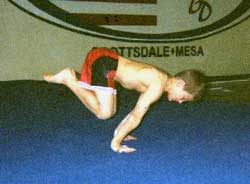
Well I played around with the progressions for a while....didn't get far.....hurt my writs....
Anyway as soon as Sommer published his book Building the Gymnastic Body I bought it..but was disappointed. Maybe I am too old, but the book seemed too "advanced" it didn't seem to take you step by step through to achieving the moves. I had other things to do with my time and sort of forgot about all this stuff.
Size isn't everything
So when I opened Steven's book and saw all the gymnastic moves in the later chapters I put it on one side.....I did not want to read something that was just about gymnastics: planches, levers and the manna.
However over Christmas I picked it up to read. I felt guilty that Steven had sent it to me and I had it there virtually unopened. Well I am glad I came back to it! When I actually started to read it I was very impressed.
A great achievement!
As soon as I started reading properly I realised what I had in my hands. To be honest I do not see this as primarily a book on bodyweight training or even gymnastics. I would class it as an Exercise Physiology text. Steven's academic background, training to be a physio is obvious and gives him a great advantage as a writer.
Across 18 chapters and 240 pages Steven gives the reader a thorough education in the physiology of strength, muscle contraction and hypertrophy, goal setting, programme design and much more. There is a dense section on how to deal with injuries and also how to address health factors such as sleep and nutrition (paleo of course!). Each chapter has a helpful summary at the end to allow you to absorb the key points. With bodyweight training progression is all about changing the mechanics and the levers, playing with the moment arm so that the positions become harder. Naturally this leads to gymnastics. I had not really appreciated that initially, but reflecting on it there is a clear logic.
The final section of the book is a huge resource of exercise descriptions, with techniques and tips all illustrated with useful drawings.
Problems?
Of course there are some elements within it that I would not endorse for everyone. I think the training frequency that Steven recommends to too high for most and I personally think the "science" of programme design is maybe not as settled as it might be.
Safety is also my prime concern as I get older. I want to use moves for my exercise that are a risk free as possible. Without coaching and spotters I would avoid lots of the moves as too risky for many people; however the moves are scaleable.
For basic bodyweight training I'd usually point people to the routine in McGuff's article here or what I will recommend in Hillfit. Still if you are interested in developing skills in gymnastics, then this is the book for you. Indeed, this is the book that I thought I was going to get when I ordered Gymnastic Bodies! It is well constructed, logically put together and reads well.
Injuries and Health
As I said this is a massive book that must have absorbed Steven's life for months in putting it together. The sections on injuries alone would make it worth the purchase price. Indeed, if you were to read no other parts of the book and ignore all of the gymnastics stuff, focussing only on chapters 12-18 then you would know more about injury, rehabilitation and prehabilitation than many health professionals. Even if you were to disagree with Steven's training approach or methodology, this section on injuries is excellent and worthwhile for anyone. That section would have made a book in its own right that would have been worth the price.

Summary
A recommended book
- A huge volume of information
- Excellent section on injuries and health
- Good primer on exercise physiology
- Superb resource on gymnastic skills and moves (if that is your interest)
Sunday, November 13, 2011
Wednesday, September 7, 2011
Sunday, January 23, 2011
Sunday, June 27, 2010
How to do a planche
I think I've given up on trying to do this.....but if you want to dedicate some time to learning:
Friday, June 18, 2010
Wow....9 yr old does a planche
In this video a 9 year old athlete is performing a solid straddle planche on the rings for 5 seconds followed by a legs together straight body planche for 2 seconds. This is one of the strongest planches on the still rings in the United States; regardless of age.
Please note the completely straight elbows and extended hips during his planche work. This "locked elbow" strength is essential in order to progress onward to more advanced ring strength elements and must be quite carefully and progressively developed.
Further professional training advice as well as thousands of in-depth discussions regarding this type of conditioning is available at:
http://GymnasticBodies.com/forum
Tuesday, June 8, 2010
How to build up to a handstand.....
Here is a guest post from Logan Christopher. Logan runs a website specialising in hand-balancing and offered to do a post for this blog. I asked for something on how to do a handstand.......
The problem with the freestanding handstand is that it is too hard a skill for most people to jump right into. Maybe you have experience doing them against the wall, but even that is not enough to start balancing out in the open.
I know! I took the long road, falling over so many times, while just inching along in my ability to do the handstand.
But there is a better way. Instead of kicking up into a handstand and hoping you’ll be able to stay in it for more than three seconds you can take a more systematic approach.
There are certain skills that work to build the component parts of doing a handstand, yet are easier than the handstand itself to progress in and master.
In the article you’ll find out what those skills are, how to do them, and how they’ll help you with the eventual goal of hitting the handstand.
Handstand Against the Wall - Kickup into a handstand against the wall. Make sure your arms are locked out and you are pushing yourself away from the ground. This creates a locked out feel and makes this position rely on your bone structure more than your muscles. The wall handstand gets you use to the position of the handstand. It also builds strength and endurance.
Frogstand - Squat down on the ground. Place your hands shoulder width apart on the floor. With the elbows bent place your knees on the outside back of them. Begin to tip forward until you find yourself in a balance.
The frogstand gets you use to controlling your balance with your hands. This much needed skill allows you to go from over or under balancing and back to a stable position. As the frogstand is low to the ground it is much easier than the handstand.
Headstand - Place your head on the floor with your hands a little in advance of your face, forming a triangle or tripod. Jump or raise you legs up until they are overhead. Be prepared to roll out of position if you overbalance. And if you’ve never done this before you may want to try it against the wall before going out in the open.
The headstand teaches you to balance your body in the air, while taking the arms and hands out of the equation. Again it is easier than the handstand as you are lower to the ground and have a wider base of support.
These three moves are integral in teaching you what you need to learn in order to do a freestanding handstand. By practicing these skills and being able to hold them easily and consistently you‘ll be much better off when you start your work on the handstand.
There are other lead-up stunts as well as important factors in learning the handstand.
I’ve just released a 30 minute handstand system video on my site, http://www.lostartofhandbalancing.com, that is available for free for a limited time.
The problem with the freestanding handstand is that it is too hard a skill for most people to jump right into. Maybe you have experience doing them against the wall, but even that is not enough to start balancing out in the open.
I know! I took the long road, falling over so many times, while just inching along in my ability to do the handstand.
But there is a better way. Instead of kicking up into a handstand and hoping you’ll be able to stay in it for more than three seconds you can take a more systematic approach.
There are certain skills that work to build the component parts of doing a handstand, yet are easier than the handstand itself to progress in and master.
In the article you’ll find out what those skills are, how to do them, and how they’ll help you with the eventual goal of hitting the handstand.
Handstand Against the Wall - Kickup into a handstand against the wall. Make sure your arms are locked out and you are pushing yourself away from the ground. This creates a locked out feel and makes this position rely on your bone structure more than your muscles. The wall handstand gets you use to the position of the handstand. It also builds strength and endurance.
Frogstand - Squat down on the ground. Place your hands shoulder width apart on the floor. With the elbows bent place your knees on the outside back of them. Begin to tip forward until you find yourself in a balance.
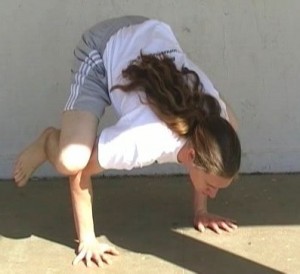
The frogstand gets you use to controlling your balance with your hands. This much needed skill allows you to go from over or under balancing and back to a stable position. As the frogstand is low to the ground it is much easier than the handstand.
Headstand - Place your head on the floor with your hands a little in advance of your face, forming a triangle or tripod. Jump or raise you legs up until they are overhead. Be prepared to roll out of position if you overbalance. And if you’ve never done this before you may want to try it against the wall before going out in the open.
The headstand teaches you to balance your body in the air, while taking the arms and hands out of the equation. Again it is easier than the handstand as you are lower to the ground and have a wider base of support.
These three moves are integral in teaching you what you need to learn in order to do a freestanding handstand. By practicing these skills and being able to hold them easily and consistently you‘ll be much better off when you start your work on the handstand.
There are other lead-up stunts as well as important factors in learning the handstand.
I’ve just released a 30 minute handstand system video on my site, http://www.lostartofhandbalancing.com, that is available for free for a limited time.
Tuesday, May 25, 2010
Wednesday, March 3, 2010
An amazing 5 year old.....
This is freaky. I must admit I wonder how "healthy" this is for the kid.
There are other videos that I can't embed....but check out the kid's physique in this one!
There are other videos that I can't embed....but check out the kid's physique in this one!
Saturday, February 20, 2010
Handstand Tutorial
I'd given up trying to master a handstand but I might give it another go. Nice tutorial. Hat tip to the Barbarians
Sunday, January 31, 2010
Assisted One Arm Handstand Pushup
Jim from Beast Skills is training for a one arm handstand pushup. He is almost there.
This is what he says:
In 1954, Roger Bannister was the first man to run a sub-4-minute mile. Within 3 years, 16 other runners had also. The psychological barrier had been broken.
The one arm handstand pushup holds a similar mystique. While some say it is impossible, others are busy training for it.
I've been working my one arm handstand a lot, and my pressing strength is the best it has been. Here now is some work with the assisted one arm handstand pushup. I'll say I prefer the 2-3 finger assist the best.
Tuesday, August 11, 2009
Saturday, August 1, 2009
Extreme Muscle Ups
The Muscle Up has become something of gold standard in upper body gymnastic moves. CrossFit makes a lot of it. Usually done on rings - but also on a high bar - it is basically a pull up followed by a dip.
Fair enough.
These two are taking it to extremes. First of all a guy doing it with one arm.
Then the guy from Beast Skills - a great athlete by the way - shows a progression to this by doing a one arm muscle up with one arm assisting.
Fair enough.
These two are taking it to extremes. First of all a guy doing it with one arm.
Then the guy from Beast Skills - a great athlete by the way - shows a progression to this by doing a one arm muscle up with one arm assisting.
Wednesday, July 29, 2009
Subscribe to:
Posts (Atom)