So I was reading a standard journalists piece about the Tabata protocol - you know: "Get fit in 4 minutes!!!" and all that. So far so good - this stuff keeps popping up every now and again as a journalist discovers interval training and decides to break it to the world.
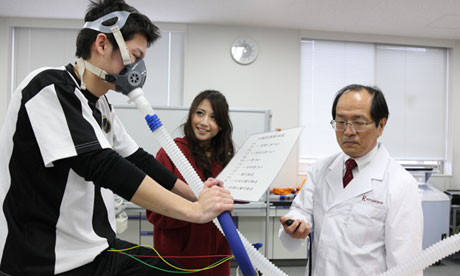
Anyway, what was different in this one was that they actually spoke to Tabata himself. He stressed something that I mentioned in the Wingate post - you need to work very very hard:
Tabata is addressing this by staging his own PR campaign:
So we are facing an official Tabata instructor and DVD programme.
The story is at
Oh well....here we go.
Anyway, what was different in this one was that they actually spoke to Tabata himself. He stressed something that I mentioned in the Wingate post - you need to work very very hard:
"....I often go on YouTube and, while I am honoured that people are doing it, some are doing it wrong because they don't realise the intensity you need to work at," says Tabata.
Tabata is addressing this by staging his own PR campaign:
It's slightly surprising, therefore, that the plan is still the preserve of the serious athlete and musclehead crowd – although that may change now that Tabata has agreed a deal with Universal Studios that will lead to a network of instructors and a DVD range released towards the end of the year.
So we are facing an official Tabata instructor and DVD programme.
The story is at
The Tabata workout programme: harder, faster, fitter, quicker?
Oh well....here we go.
Comments
I think that if they keep it honest the instructors and DVD will come with a lengthy legal disclaimer for when someone keels over.
It's one way to go about it, I suppose, but there are far less stressful ways to achieve the same results.
The takeaway message from Tabata isn't the duty cycle. It's the intensity. Same thing Dr. McGuff talks about in BBS: you have to stress the anaerobic side of metabolism for exercise to be useful. And, it doesn't have to happen that often.
There were some questions raised as to how sustainable the Tabata protocol would be in the long term anyway. I should imagine, without supervision and outside motivation....not very. Doing intervals where a constant pace is targeted throughout, and where the last few are only "really" hard, seems effective enough, and sustainable for most of us. It's similar in nature to one hard resistance set done HIT style and 4 sets of say 10 reps, where only the last set is taken to failure. If progress is made, they both get to the same destination. I've always done my intervals in the slightly less intense method, and always made progress over the long term. That was the key, I could mentally sustain it LONG TERM, and not burn out after a few weeks. I was able to mentally leave something in the tank, and therefore return the following week, making slight adjustments to account for progress, while not fearing what was to come so much, that I was already making excuses not to do it.
Winett's conclusions are very sound, and based upon his desire to make his training sustainable both mentally AND physically, in order to preserve his structure and joints for his main passion of resistance training, and in order not to negatively affect his life outside the gym. His account can be read here.... http://ageless-athletes.com/sustainable_training_dec2012.php#continue
That said, I doubt that even most competitive athletes will ever have to exercise this hard to excel in their respective sports.
And certainly no one needs to exercise this hard for health.
In Tabata's experiment, they measured 170% VO2max. Which to me was just the technical way of saying "anaerobic." I agree that for most of us 170% VO2max is not realistic or necessary, but anaerobic is.
Is there a practical way to check it without any devices?
Thanks, Ferry
Very hard==I threw up.
Hard==I felt like throwing up.
Good==hand were shaking, didn't feel like moving.
easy==breathing heavy, some sweat.