
Wednesday, June 30, 2010
The congruent chin
A great video from Bill DeSimone (I interviewed him here if you want more ideas on his approach) Superb stuff, you will not find anywhere else!


Strict Judging....
Very Strict judges here on the 420kg deadlift from the amazing Konstantinovs. I'd have given it to him.
Low carb diets and strength training
Just saw this abstract - lower calories whether low carb or not - can help to lose body-weight but won't affect strength? So you don't need carbs to display strength.
Effects of short-term very low-carbohydrate or conventional diet on strength performance
AIM: Weight reduction strategies usually include diet and regular physical activity. A very low-carbohydrate and high protein diet (VLCD) may be preferred instead of a low energy conventional diet (CONV). The effects of VLCD on strength performance are yet to be understood. Aim of the study is to determine the effects of two different restrictive diets on strength performance.
METHODS: Sedentary women were assigned to either a VLCD (less than 40 g carbohydrate; n=12) or a CONV diet (500 to 800 kcal restrictive; 48%, 22% and 30% from carbohydrate, protein and fat, respectively; n=12). Knee extension isokinetic strength tests (3 yen 15 reps at 60 degrees .s-1, with 90 or 180 s rest interval between sets) were performed prior and after a one week diet period.
RESULTS:Both groups reduced body mass (VLCD: -2.6+/-1.0% vs. CONV: -1.9+/-1.3%; P<0.05), with no between diets effect. The sum of the total work in three sets (ATW) was 4850+/-1002 J vs. 4801+/-973 J with 90 s rest interval, and 4812+/-1174 J vs. 4812+/-1210 J with 180 s rest interval, respectively, in the pre vs. post-VLCD period. For CONV, values were 4709+/-729 J vs. 4530+/-996 J with 90 s rest interval, and 4760+/-732 J vs. 4816+/-702 J with 180 s rest interval, respectively, in the pre vs. post-CONV treatment. No significant differences were detected in the ATW between groups.
CONCLUSION: Short-term hypoenergetic diets, irrespective of the carbohydrate content, seem to reduce significantly body mass, but do not impair acute strength performance.
Effects of short-term very low-carbohydrate or conventional diet on strength performance
AIM: Weight reduction strategies usually include diet and regular physical activity. A very low-carbohydrate and high protein diet (VLCD) may be preferred instead of a low energy conventional diet (CONV). The effects of VLCD on strength performance are yet to be understood. Aim of the study is to determine the effects of two different restrictive diets on strength performance.
METHODS: Sedentary women were assigned to either a VLCD (less than 40 g carbohydrate; n=12) or a CONV diet (500 to 800 kcal restrictive; 48%, 22% and 30% from carbohydrate, protein and fat, respectively; n=12). Knee extension isokinetic strength tests (3 yen 15 reps at 60 degrees .s-1, with 90 or 180 s rest interval between sets) were performed prior and after a one week diet period.
RESULTS:Both groups reduced body mass (VLCD: -2.6+/-1.0% vs. CONV: -1.9+/-1.3%; P<0.05), with no between diets effect. The sum of the total work in three sets (ATW) was 4850+/-1002 J vs. 4801+/-973 J with 90 s rest interval, and 4812+/-1174 J vs. 4812+/-1210 J with 180 s rest interval, respectively, in the pre vs. post-VLCD period. For CONV, values were 4709+/-729 J vs. 4530+/-996 J with 90 s rest interval, and 4760+/-732 J vs. 4816+/-702 J with 180 s rest interval, respectively, in the pre vs. post-CONV treatment. No significant differences were detected in the ATW between groups.
CONCLUSION: Short-term hypoenergetic diets, irrespective of the carbohydrate content, seem to reduce significantly body mass, but do not impair acute strength performance.
Tuesday, June 29, 2010
Monday, June 28, 2010
Fancy shoes - don't bother
If you have ever bought running shoes from a specialist shop the assistants will likely have examined your foot and your gait and prescribed a particular style of shoe - motion control, cushioned or whatever....
Maybe it is all a waste of time and money! Chalk up another one for barefoot running.
Injury Reduction Effectiveness of Assigning Running Shoes Based on Plantar Shape in Marine Corps Basic Training
Abstract
BACKGROUND: Shoe manufacturers market motion control, stability, and cushioned shoes for plantar shapes defined as low, normal, and high, respectively. This assignment procedure is presumed to reduce injuries by compensating for differences in running mechanics. HYPOTHESIS: Assigning running shoes based on plantar shape will not reduce injury risk in Marine Corps basic training.
STUDY DESIGN: Randomized controlled clinical trial; Level of evidence, 1.
METHODS: After foot examinations, Marine Corps recruits in an experimental group (E: 408 men, 314 women) were provided motion control, stability, or cushioned shoes for plantar shapes indicative of low, medium, or high arches, respectively. A control group (C: 432 men, 257 women) received a stability shoe regardless of plantar shape. Injuries during the 12 weeks of training were determined from outpatient visits obtained from the Defense Medical Surveillance System. Other known injury risk factors (eg, fitness, smoking, prior physical activity) were obtained from a questionnaire, existing databases, or the training units.
RESULTS: Cox regression indicated little difference in injury risk between the E and C groups among men (hazard ratio [E/C] = 1.01; 95% confidence interval, 0.82-1.24) or women (hazard ratio [E/C] = 0.88; 95% confidence interval, 0.70-1.10).
CONCLUSION: This prospective study demonstrated that assigning shoes based on the shape of the plantar foot surface had little influence on injuries even after considering other injury risk factors.
Maybe it is all a waste of time and money! Chalk up another one for barefoot running.
Injury Reduction Effectiveness of Assigning Running Shoes Based on Plantar Shape in Marine Corps Basic Training
Abstract
BACKGROUND: Shoe manufacturers market motion control, stability, and cushioned shoes for plantar shapes defined as low, normal, and high, respectively. This assignment procedure is presumed to reduce injuries by compensating for differences in running mechanics. HYPOTHESIS: Assigning running shoes based on plantar shape will not reduce injury risk in Marine Corps basic training.
STUDY DESIGN: Randomized controlled clinical trial; Level of evidence, 1.
METHODS: After foot examinations, Marine Corps recruits in an experimental group (E: 408 men, 314 women) were provided motion control, stability, or cushioned shoes for plantar shapes indicative of low, medium, or high arches, respectively. A control group (C: 432 men, 257 women) received a stability shoe regardless of plantar shape. Injuries during the 12 weeks of training were determined from outpatient visits obtained from the Defense Medical Surveillance System. Other known injury risk factors (eg, fitness, smoking, prior physical activity) were obtained from a questionnaire, existing databases, or the training units.
RESULTS: Cox regression indicated little difference in injury risk between the E and C groups among men (hazard ratio [E/C] = 1.01; 95% confidence interval, 0.82-1.24) or women (hazard ratio [E/C] = 0.88; 95% confidence interval, 0.70-1.10).
CONCLUSION: This prospective study demonstrated that assigning shoes based on the shape of the plantar foot surface had little influence on injuries even after considering other injury risk factors.
Sunday, June 27, 2010
mc on the shoulder

mc ( remember mc? there is a interview with her that I did here) has put up a very detailed piece on the mechanics of the shoulder:
Part 1 : the amazing engineering that is the shoulder, part 1: scapula and shoulder girdle
Part 2 : the amazing shoulder - part 2: glenohumeral joint & muscles (yes rotator cuff too)
There is some fascinating reading there.
In part one of this quick tour of the amazing shoulder we looked particularly at the shoulder girdle and the muscles that act pretty much directly on the scapula. The main take away was that significant muscles like the traps, rhomboids, pec minor, serratus anterior and levator scapula all work pretty much *just* to move the scapula and so reposition the shoulder joint socket to extend range of motion for the arm moving in the shoulder.
In this piece, we'll overview those pixie rotator cuff muscles and look at why they can be such a pain - in the shoulder - and how understanding the movements these muscles support may help reduce injury risk.
We'll also take a quick look at the big muscles like the lats that opperate on the main shoulder joint, the glenohumral joint. From here we'll speculate about shoulder injuries and habits to avoid them.
How to do a planche
I think I've given up on trying to do this.....but if you want to dedicate some time to learning:
Thursday, June 24, 2010
Another sprint / interval study
low volume sprints and high volume intervals have the same effect in terms of this aspect of gene expression......so why spend time doing doing the long stuff?
Mitochondrial gene expression in elite cyclists: effects of high-intensity interval exercise
Mitochondrial gene expression in elite cyclists: effects of high-intensity interval exercise
Little is known about the effect of training on genetic markers for mitochondrial biogenesis in elite athletes. We tested the hypothesis that low-volume sprint interval exercise (SIE) would be as effective as high-volume interval exercise (IE). ............... We conclude that upstream genetic markers of mitochondrial biogenesis increase in a similar way in elite athletes after one exercise session of SIE and IE. However, since the volume and duration of work was considerably lower during SIE and since Tfam, the downstream target of PGC-1alpha, increased only after SIE, we conclude that SIE might be a time-efficient training strategy for highly trained individuals.
Book Review - Waist Disposal by Dr John Briffa

I've been reading John Briffa's blog for quite a while. He is a medical doctor with a column in the Observer, but is something of an opponent of the Conventional Wisdom. Basically he holds to a low carb / primal diet, but he is not really an "athlete" so his advice and analysis comes across as much more down to earth than some
He has now written a book on weightloss for men - Waist Disposal: the ultimate fat loss manual for men.
Here is an interview about the book:
This is the sort of book that you could give to your skeptical friend or your wife. It is written in accessible language but makes good reference to scientific studies to support the argument. One feature that I like is that each chapter ends with a summary of the key points. If you wanted you could just read the final page of each chapter and get a good grounding in the arguments.
All the standard stuff is here :
- why calorie counting doesn't work;
- why carbs are a problem;
- why fat isn't fattening; and
- why protein matters.
Overall it is a good book. Nothing that new if you have the sort of thing that I link to, but it is probably a book written in an accessible way so you could pass it on
Overtraining and testosterone
This is interesting and mildly disturbing:
Male functional hypogonadotropic hypogonadism (MFHH): A distinct clinical entity?
Basically in some people training too much leads to lowered levels of testosterone.
Male functional hypogonadotropic hypogonadism (MFHH): A distinct clinical entity?
Males presenting with high athletic stress or weight loss, coupled with low testosterone, may signal the rise of a new disorder -- functional hypogonadotrophic hypogonadism.
Just as women whose bodies are under stress from excessive exercise, weight loss, or psychological stress can experience hypothalamic amenorrhea, a seven-patient series suggests that a similar phenomenon may exist among men undergoing similar kinds of stress, Andrew Dwyer, MD, of Massachusetts General Hospital, said during a poster session here at the annual meeting of the Endocrine Society.
Basically in some people training too much leads to lowered levels of testosterone.
Dwyer noted that after the patients had been tested, one of them sustained a heel injury and had to stop training for a while. "He gained six pounds, and we measured his testosterone level, and serially, it stayed normal," he noted. "So with just enough removal of stress...he was able to swing back into normal testosterone production."
Another patient who decreased his training upon the researchers' recommendation was also retested and his testosterone level was up into the low end of the normal range, said Dwyer.
Friday, June 18, 2010
Wow....9 yr old does a planche
In this video a 9 year old athlete is performing a solid straddle planche on the rings for 5 seconds followed by a legs together straight body planche for 2 seconds. This is one of the strongest planches on the still rings in the United States; regardless of age.
Please note the completely straight elbows and extended hips during his planche work. This "locked elbow" strength is essential in order to progress onward to more advanced ring strength elements and must be quite carefully and progressively developed.
Further professional training advice as well as thousands of in-depth discussions regarding this type of conditioning is available at:
http://GymnasticBodies.com/forum
Wednesday, June 16, 2010
The joy of walking
This is a superb piece form the minimalist blog:
the joy of walking
the joy of walking
Today I set out from my house and walked. And walked.
I didn’t have a specific destination in mind, but wanted to walk a bit before finding a quiet place to write. So I walked, out of the town where I live and along the tropical, white-sand coastline, to the next town over.
As others drove cocooned in their cars, I walked, and emitted nothing but my breath.
As others spent their lunch hour pounding down fat-laden burgers and greasy fries or some other cheesy fried piled-high dish, I walked, and burned calories.
As others rushed and stressed, I walked, and took my time.
As others sat at their computers, I walked, and got my blood flowing.
As others held power business meetings and made deals, I walked, and had time to think.
As others were productive and got tasks done, I walked and got nothing done, and cleared my head.
As others had the comfort of shelter and air-conditioning, I walked and worked up a light sweat and was buffeted by the wind.
As a white gull floated serenely above a calm bay, I walked, and watched, and loved it.
I walked for an hour, then wrote and read, and then walked for another hour to get back home, tired but happy.
I can’t walk this much every day, but I walk as much as I can, because you need nothing to walk, you spend nothing, you consume nothing, you emit nothing.
And yet you have everything.
Getting older.....losing muscle
Here is another.
I saw this abstract today. As you get older you lose muscle - sarcopenia they call it. It is a bad thing because it sets you up for injury. Muscle is also useful to the body metabolically too as a reservoir of nutrients and reserves. Anyway, maintaining your muscle mass as you age is very beneficial.
My normal assumption is that people lose muscle because they become less active. Old people exercise less.....if only they would keep training then this would be better.....
This abstract of a study makes things a little more depressing. The problem seems to be down to metabolic changes - people become resistant to anabolic stimuli - i.e. the exercise that used to make you grow muscle becomes ineffective. The study relates to endurance exercise. I wonder if it would apply equally to resistance training?
Age-related anabolic resistance after endurance-type exercise in healthy humans
Age-related skeletal muscle loss is thought to stem from suboptimal nutrition and resistance to anabolic stimuli. Impaired microcirculatory (nutritive) blood flow may contribute to anabolic resistance by reducing delivery of amino acids to skeletal muscle. In this study, we employed contrast-enhanced ultrasound, microdialysis sampling of skeletal muscle interstitium, and stable isotope methodology, to assess hemodynamic and metabolic responses of older individuals to endurance type (walking) exercise during controlled amino acid provision. We hypothesized that older individuals would exhibit reduced microcirculatory blood flow, interstitial amino acid concentrations, and amino acid transport when compared with younger controls. We report for the first time that aging induces anabolic resistance following endurance exercise, manifested as reduced (by approximately 40%) efficiency of muscle protein synthesis. Despite lower (by approximately 40-45%) microcirculatory flow in the older than in the younger participants, circulating and interstitial amino acid concentrations and phenylalanine transport into skeletal muscle were all equal or higher in older individuals than in the young, comprehensively refuting our hypothesis that amino acid availability limits postexercise anabolism in older individuals. Our data point to alternative mediators of age-related anabolic resistance and importantly suggest correction of these impairments may reduce requirements for, and increase the efficacy of, dietary protein in older individuals.
I saw this abstract today. As you get older you lose muscle - sarcopenia they call it. It is a bad thing because it sets you up for injury. Muscle is also useful to the body metabolically too as a reservoir of nutrients and reserves. Anyway, maintaining your muscle mass as you age is very beneficial.
My normal assumption is that people lose muscle because they become less active. Old people exercise less.....if only they would keep training then this would be better.....
This abstract of a study makes things a little more depressing. The problem seems to be down to metabolic changes - people become resistant to anabolic stimuli - i.e. the exercise that used to make you grow muscle becomes ineffective. The study relates to endurance exercise. I wonder if it would apply equally to resistance training?
Age-related anabolic resistance after endurance-type exercise in healthy humans
Age-related skeletal muscle loss is thought to stem from suboptimal nutrition and resistance to anabolic stimuli. Impaired microcirculatory (nutritive) blood flow may contribute to anabolic resistance by reducing delivery of amino acids to skeletal muscle. In this study, we employed contrast-enhanced ultrasound, microdialysis sampling of skeletal muscle interstitium, and stable isotope methodology, to assess hemodynamic and metabolic responses of older individuals to endurance type (walking) exercise during controlled amino acid provision. We hypothesized that older individuals would exhibit reduced microcirculatory blood flow, interstitial amino acid concentrations, and amino acid transport when compared with younger controls. We report for the first time that aging induces anabolic resistance following endurance exercise, manifested as reduced (by approximately 40%) efficiency of muscle protein synthesis. Despite lower (by approximately 40-45%) microcirculatory flow in the older than in the younger participants, circulating and interstitial amino acid concentrations and phenylalanine transport into skeletal muscle were all equal or higher in older individuals than in the young, comprehensively refuting our hypothesis that amino acid availability limits postexercise anabolism in older individuals. Our data point to alternative mediators of age-related anabolic resistance and importantly suggest correction of these impairments may reduce requirements for, and increase the efficacy of, dietary protein in older individuals.
your voice reveals how strong you are!...and how you can fight
This is fascinating....
Both men and women can accurately assess a man's upper body strength based on his voice alone, suggesting that the male voice may have evolved as an indicator of fighting ability. (hat tip to the New Scientist)
It is really interesting that it all comes back to fighting too.
Adaptations in humans for assessing physical strength from the voice
Recent research has shown that humans, like many other animals, have a specialization for assessing fighting ability from visual cues. Because it is probable that the voice contains cues of strength and formidability that are not available visually, we predicted that selection has also equipped humans with the ability to estimate physical strength from the voice. We found that subjects accurately assessed upper-body strength in voices taken from eight samples across four distinct populations and language groups: the Tsimane of Bolivia, Andean herder-horticulturalists and United States and Romanian college students. Regardless of whether raters were told to assess height, weight, strength or fighting ability, they produced similar ratings that tracked upper-body strength independent of height and weight. Male voices were more accurately assessed than female voices, which is consistent with ethnographic data showing a greater tendency among males to engage in violent aggression. Raters extracted information about strength from the voice that was not supplied from visual cues, and were accurate with both familiar and unfamiliar languages. These results provide, to our knowledge, the first direct evidence that both men and women can accurately assess men's physical strength from the voice, and suggest that estimates of strength are used to assess fighting ability.
Both men and women can accurately assess a man's upper body strength based on his voice alone, suggesting that the male voice may have evolved as an indicator of fighting ability. (hat tip to the New Scientist)
It is really interesting that it all comes back to fighting too.
Adaptations in humans for assessing physical strength from the voice
Recent research has shown that humans, like many other animals, have a specialization for assessing fighting ability from visual cues. Because it is probable that the voice contains cues of strength and formidability that are not available visually, we predicted that selection has also equipped humans with the ability to estimate physical strength from the voice. We found that subjects accurately assessed upper-body strength in voices taken from eight samples across four distinct populations and language groups: the Tsimane of Bolivia, Andean herder-horticulturalists and United States and Romanian college students. Regardless of whether raters were told to assess height, weight, strength or fighting ability, they produced similar ratings that tracked upper-body strength independent of height and weight. Male voices were more accurately assessed than female voices, which is consistent with ethnographic data showing a greater tendency among males to engage in violent aggression. Raters extracted information about strength from the voice that was not supplied from visual cues, and were accurate with both familiar and unfamiliar languages. These results provide, to our knowledge, the first direct evidence that both men and women can accurately assess men's physical strength from the voice, and suggest that estimates of strength are used to assess fighting ability.
Walking 100 miles
This is an interesting interview with a man in his 60s who regularly competes in 100 miles walking events.
I would walk 100 miles
I would walk 100 miles
Tony Deall is a retired GP from Penrith. He is also secretary of the Cumbrian branch of the Long Distance Walkers Association (LDWA). In late May, in Perthshire, he was one of 352 people who completed the LDWA’s annual 100-mile walk, finishing the route (actually 104.4 miles) in 32 hours 56 minutes, joint-80th.
Monday, June 14, 2010
More more on single leg exercises
Following on from the post on the benefits of single leg moves for low back health....there are a couple of other useful posts on single leg training:
Single Leg Supplements
Build Bigger Legs, One at a Time
Single Leg Supplements
Build Bigger Legs, One at a Time
Single Leg Exercise
I thought this was an interesting post from Zach about single leg exercises and how they can promote low back health and resilience.
Single Leg Exercise:
Single Leg Exercise:
Single leg exercises do one thing especially well and that is hit the quatratus lumborum. One of the QL’s main functions is to laterally stabilize the pelvis in a single leg stance. One place this is important in everyday life is just simply walking. Each steprequires the QL to hold the pelvis up so to speak. If the QL doesn’t do its job the pelvis will drop. When this begins to happen, low back problems aren’t far away.
The humble pushup
Talking of bodyweight training, Keith pointed to this excellent article:
What You Don’t Know about the Push-up
What You Don’t Know about the Push-up
The push-up is quite possibly one of the best exercises athletes can do. Most athletes and coaches only associate push-ups with the chest and triceps, but they’re a great exercise for upper back strength and shoulder proprioception as well as for ingraining proper torso stability patterns.
Reaping the benefits of the push-up means focusing on correct technique first and foremost. I believe throwing athletes should have push-ups in every phase of their program. At TCU, our baseball athletes and quarterbacks incorporate some form of the push-up year round in their training. At various times, we even eliminate all forms of pressing in lieu of the push-up and its many variations.
So why is the push-up so good?
Sleep......quality matters
I haven't had anything up about sleep for a while. Sleep is so important - e.g. to sports performance or even to performing well on Guitar Hero - and personally I am very poor at the discipline of getting to bed early enough to get enough.
Anyway, there was an interesting article in the Independent the other day with some interesting material on sleep.
Anyway, there was an interesting article in the Independent the other day with some interesting material on sleep.
"The biggest myths are that we need seven or eight hours a day, or that we shouldn't wake up in the night," continues Ramlakhan. "But waking early in the morning is perfectly normal. Students can still function well in an exam if they don't sleep the previous night. I sometimes professionally advise football players and I tell them not to worry about sleep before a big game. Even if they don't manage to sleep perfectly they will still perform well." So what's the key to an effective slumber? Ramlakhan explains the dos and don'ts of catching Z's
Wheat intolerance
Although I generally follow a low carb diet I am not that strict in terms of paleo - I have not been avoiding grains and I love dairy fat - cream and yoghurt.
However I've recently been finding that I do not tolerate gluten well. After bread, pasta, beer I just feel rough - bloating and gas and cramping in the guts. Beer makes me sneeze.
Anyway I went to the doctor and was tested for celiac disease. The test came back negative, but the doctor explained that testing negative for the antibodies that would indicate celiac disease only ruled out that particular disease. The symptoms indicated a reaction to wheat, so she recommended avoiding it for a while to see how I felt. I am therefore making an effort to be gluten free. Easy usually but eating out and snacks when hillwalking or backpacking are more of a challenge.
Rusty had a good post on Wheat Intolerance. Mark Sisson's post on on Grains is also worth reading
However I've recently been finding that I do not tolerate gluten well. After bread, pasta, beer I just feel rough - bloating and gas and cramping in the guts. Beer makes me sneeze.
Anyway I went to the doctor and was tested for celiac disease. The test came back negative, but the doctor explained that testing negative for the antibodies that would indicate celiac disease only ruled out that particular disease. The symptoms indicated a reaction to wheat, so she recommended avoiding it for a while to see how I felt. I am therefore making an effort to be gluten free. Easy usually but eating out and snacks when hillwalking or backpacking are more of a challenge.
Rusty had a good post on Wheat Intolerance. Mark Sisson's post on on Grains is also worth reading
One Leg Squat variation - Airborne
Adam Steer demonstrates an alternative single leg squat. (He wrote something for this blog way back). I prefer this move to the standard "pistol".
To me it is more natural, it coicides more with everyday single leg activity. The usual pistol with the free leg extended in front of the body always seems contrived. I can't think of natural movements where you have one leg on the ground and the other extended in front - there may be some but I can't think of any. However there are lots - e.g walking, or climbing stairs - where the free leg is behind you.
I must admit that I've been thinking more and more about bodyweight training recently. With the rest of my life being busy one thing I want is to be injury free and sometimes weights just seem to bring hte potential for more injuries. Mark Sisson's recent post got me thinking about this idea.
In the past I've occaisionally pointed to Craig Ballantyne's material for decent basic workouts - e.g. the free bodyweight workouts that I posted here.
He has some new bodyweight stuff out that looks interesting looking at either a bodybuilding or cardio focus. Maybe worth checking out
To me it is more natural, it coicides more with everyday single leg activity. The usual pistol with the free leg extended in front of the body always seems contrived. I can't think of natural movements where you have one leg on the ground and the other extended in front - there may be some but I can't think of any. However there are lots - e.g walking, or climbing stairs - where the free leg is behind you.
I must admit that I've been thinking more and more about bodyweight training recently. With the rest of my life being busy one thing I want is to be injury free and sometimes weights just seem to bring hte potential for more injuries. Mark Sisson's recent post got me thinking about this idea.
In the past I've occaisionally pointed to Craig Ballantyne's material for decent basic workouts - e.g. the free bodyweight workouts that I posted here.
He has some new bodyweight stuff out that looks interesting looking at either a bodybuilding or cardio focus. Maybe worth checking out
Tuesday, June 8, 2010
How to build up to a handstand.....
Here is a guest post from Logan Christopher. Logan runs a website specialising in hand-balancing and offered to do a post for this blog. I asked for something on how to do a handstand.......
The problem with the freestanding handstand is that it is too hard a skill for most people to jump right into. Maybe you have experience doing them against the wall, but even that is not enough to start balancing out in the open.
I know! I took the long road, falling over so many times, while just inching along in my ability to do the handstand.
But there is a better way. Instead of kicking up into a handstand and hoping you’ll be able to stay in it for more than three seconds you can take a more systematic approach.
There are certain skills that work to build the component parts of doing a handstand, yet are easier than the handstand itself to progress in and master.
In the article you’ll find out what those skills are, how to do them, and how they’ll help you with the eventual goal of hitting the handstand.
Handstand Against the Wall - Kickup into a handstand against the wall. Make sure your arms are locked out and you are pushing yourself away from the ground. This creates a locked out feel and makes this position rely on your bone structure more than your muscles. The wall handstand gets you use to the position of the handstand. It also builds strength and endurance.
Frogstand - Squat down on the ground. Place your hands shoulder width apart on the floor. With the elbows bent place your knees on the outside back of them. Begin to tip forward until you find yourself in a balance.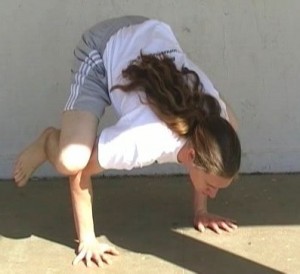
The frogstand gets you use to controlling your balance with your hands. This much needed skill allows you to go from over or under balancing and back to a stable position. As the frogstand is low to the ground it is much easier than the handstand.
Headstand - Place your head on the floor with your hands a little in advance of your face, forming a triangle or tripod. Jump or raise you legs up until they are overhead. Be prepared to roll out of position if you overbalance. And if you’ve never done this before you may want to try it against the wall before going out in the open.
The headstand teaches you to balance your body in the air, while taking the arms and hands out of the equation. Again it is easier than the handstand as you are lower to the ground and have a wider base of support.
These three moves are integral in teaching you what you need to learn in order to do a freestanding handstand. By practicing these skills and being able to hold them easily and consistently you‘ll be much better off when you start your work on the handstand.
There are other lead-up stunts as well as important factors in learning the handstand.
I’ve just released a 30 minute handstand system video on my site, http://www.lostartofhandbalancing.com, that is available for free for a limited time.
The problem with the freestanding handstand is that it is too hard a skill for most people to jump right into. Maybe you have experience doing them against the wall, but even that is not enough to start balancing out in the open.
I know! I took the long road, falling over so many times, while just inching along in my ability to do the handstand.
But there is a better way. Instead of kicking up into a handstand and hoping you’ll be able to stay in it for more than three seconds you can take a more systematic approach.
There are certain skills that work to build the component parts of doing a handstand, yet are easier than the handstand itself to progress in and master.
In the article you’ll find out what those skills are, how to do them, and how they’ll help you with the eventual goal of hitting the handstand.
Handstand Against the Wall - Kickup into a handstand against the wall. Make sure your arms are locked out and you are pushing yourself away from the ground. This creates a locked out feel and makes this position rely on your bone structure more than your muscles. The wall handstand gets you use to the position of the handstand. It also builds strength and endurance.
Frogstand - Squat down on the ground. Place your hands shoulder width apart on the floor. With the elbows bent place your knees on the outside back of them. Begin to tip forward until you find yourself in a balance.
The frogstand gets you use to controlling your balance with your hands. This much needed skill allows you to go from over or under balancing and back to a stable position. As the frogstand is low to the ground it is much easier than the handstand.
Headstand - Place your head on the floor with your hands a little in advance of your face, forming a triangle or tripod. Jump or raise you legs up until they are overhead. Be prepared to roll out of position if you overbalance. And if you’ve never done this before you may want to try it against the wall before going out in the open.
The headstand teaches you to balance your body in the air, while taking the arms and hands out of the equation. Again it is easier than the handstand as you are lower to the ground and have a wider base of support.
These three moves are integral in teaching you what you need to learn in order to do a freestanding handstand. By practicing these skills and being able to hold them easily and consistently you‘ll be much better off when you start your work on the handstand.
There are other lead-up stunts as well as important factors in learning the handstand.
I’ve just released a 30 minute handstand system video on my site, http://www.lostartofhandbalancing.com, that is available for free for a limited time.
Monday, June 7, 2010
Back to the hills

Managed to get away up north for a few days into the hills. This was taken from Cul Mor looking down on Stac Polliadh in Assynt. A fantastic day. (Click on the photo for a bigger, better version)
I've been working too much and not training enough recently so I really felt this one. Time to start proper training again.
Sunday, June 6, 2010
Subscribe to:
Posts (Atom)